Is Montmartre Difficult To Walk?
Montmartre sits on Paris's highest hill, and the walk up involves real stairs and cobbles. Here is an honest look at the effort involved, the funicular shortcut and which guided walks suit a slower pace.
Is Montmartre Difficult To Walk?
Montmartre is moderately difficult to walk, and the difficulty is concentrated rather than constant. The butte is the highest hill in Paris, the public route to Sacre-Coeur covers 222 steps, and most streets are cobbled or sloped. Flat stretches exist on top of the hill and along the boulevards below, so with the funicular, sensible shoes and a slow pace, the large majority of visitors manage it comfortably. Since those cobbles and steps punish flimsy footwear, our guide to dressing for Paris and its hills covers the shoes and clothing choices that make the climb easier.
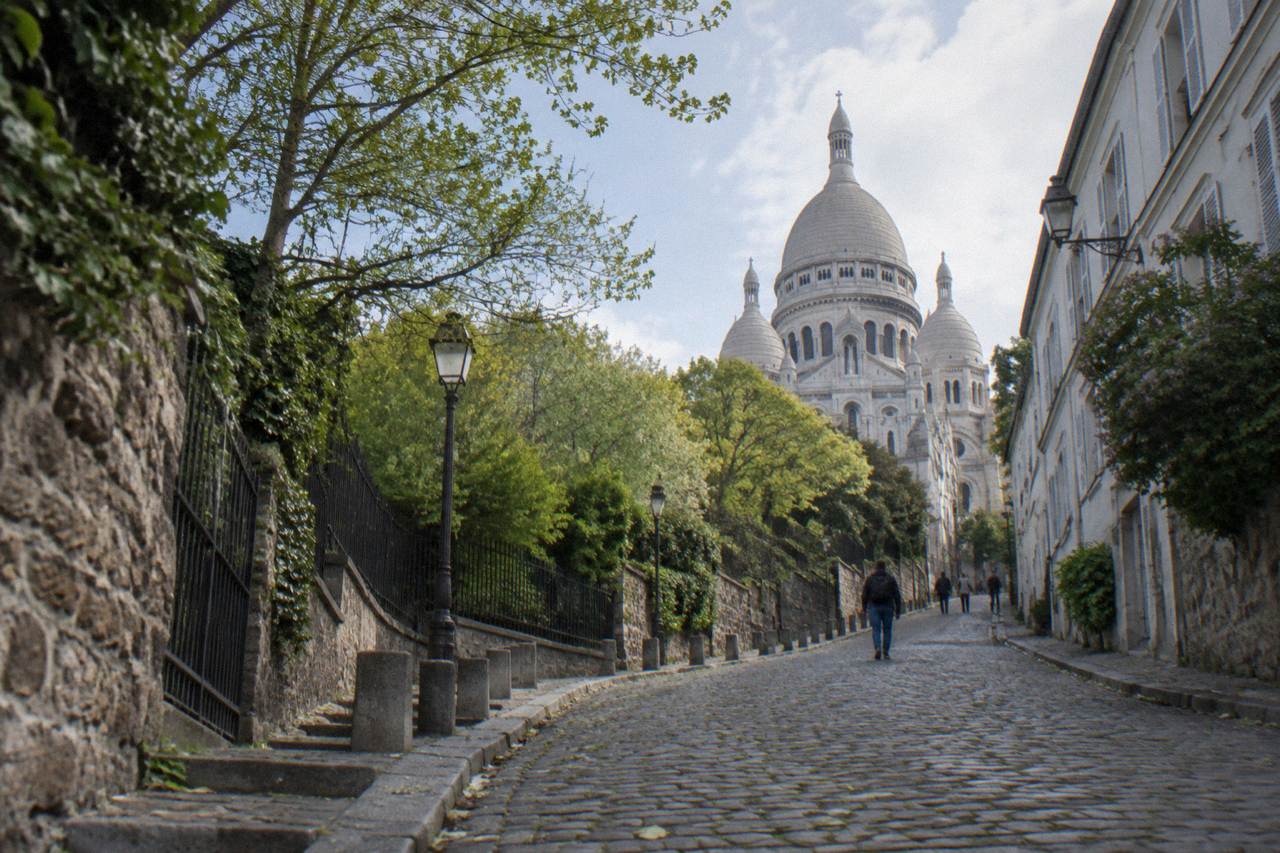
The honest answer depends on where you are on the hill. The lower slopes around Boulevard de Clichy and Boulevard de Rochechouart are ordinary city streets, flat and wide. The effort begins when you head uphill toward the basilica, and it comes in short, steep bursts rather than one long climb. Rue Foyatier, the stepped street beside the funicular, and the gardens of Square Louise Michel are the two classic ascents, and both deposit you at the same place: the parvis in front of Sacre-Coeur.
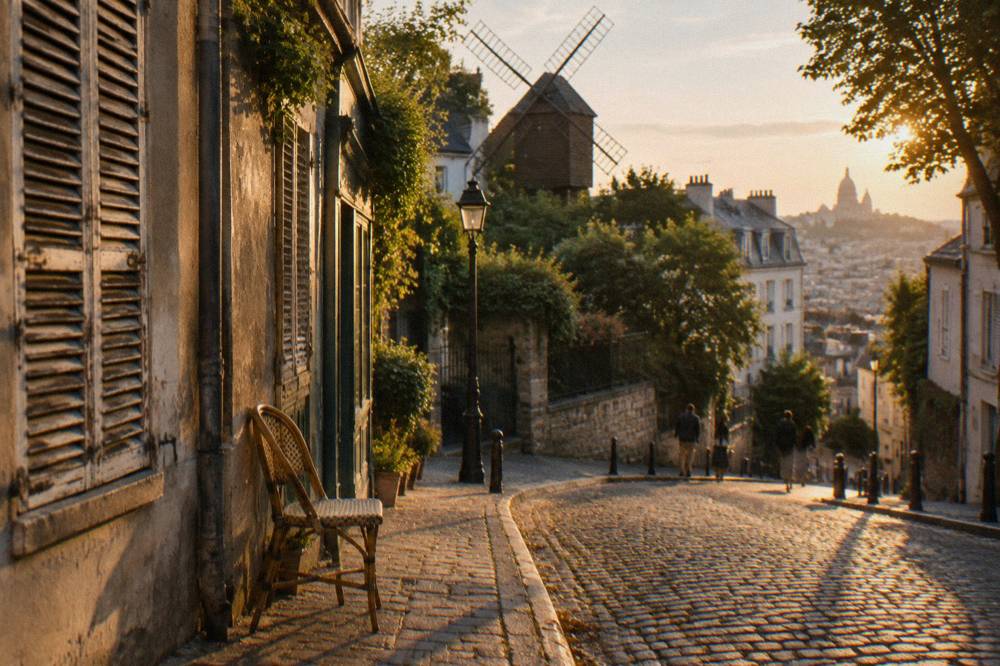
Once you are on top, the reward is that the plateau is comparatively gentle. Place du Tertre, rue des Abbesses and the lanes around the Musee de Montmartre roll rather than plunge, though rue Lepic, the street that runs down toward the boulevards, descends steadily and climbs back the same way. Visitors who pace themselves, rest at cafes and treat the hill as a half-day rather than a sprint rarely report problems. Those who try to see everything in ninety minutes, in poor shoes, in August heat, are the ones who find it hard. If you would rather skip the daytime crowds altogether, the evening guide to walking Montmartre after dark explains which parts of the hill stay lit and how to plan a night stroll.
The steepest single feature on the hill is not a street at all but an optional one: the dome of Sacre-Coeur. The basilica itself is free to enter, open every day from 6:30am to 10:30pm, and reached by a final short flight of steps from the parvis. The dome is a separate, ticketed climb, which we come to below.
If a guided walk is part of your plan, the format matters as much as the hill. The small-group walk that meets by the Moulin Rouge caps its groups at 10 and moves at a guide's conversational pace, while the shorter 90-minute walks keep the route tight. Here are three listings that suit visitors watching their legs:
Each of these runs in daytime slots, so check departure times on the live listing for your date before you plan the day around one.
How Steep Is The Climb To Sacre-Coeur?
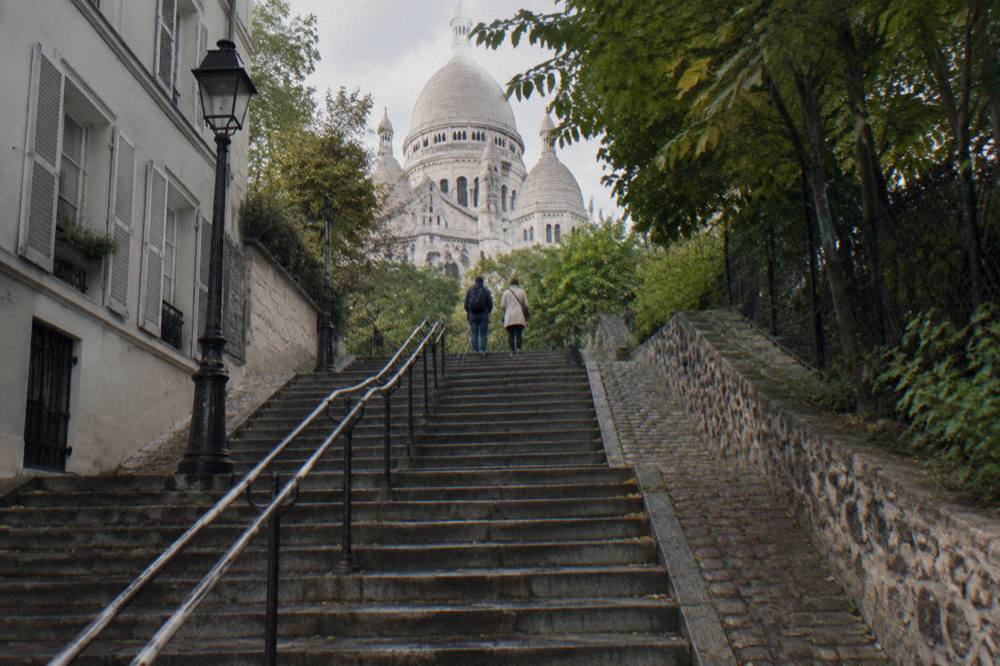
The main public ascent to Sacre-Coeur is 222 steps, either as the stepped rue Foyatier or through the terraced Square Louise Michel. The steps come in short flights with landings, not one unbroken staircase, and the whole climb takes most people five to ten minutes. The basilica is free to enter once you arrive, open daily from 6:30am to 10:30pm.
The figure of 222 steps comes from the Paris tourism office, which counts the public stairs from the base of the hill to the basilica forecourt. In practice the climb feels shorter than the number suggests because the Square Louise Michel route breaks it into garden terraces with benches, water features and views, so you can rest between flights. Rue Foyatier, by contrast, is a straight stepped street beside the funicular, exposed to the sun and with no shade on the flights themselves. On a warm afternoon the garden route is the kinder of the two.
At the top, the parvis gives you the famous view over Paris, and entering the basilica costs nothing. The interior is open every day, and the site asks for decent clothing and a quiet attitude, with no photography permitted in the nave. A wait of 10 to 15 minutes is possible at busy times, roughly between 10:30am and 5pm, because the entrance is screened but not ticketed.
The one genuinely demanding feature on the hill sits above the parvis: the dome. Dome access is by 280 steps up a narrow staircase, with no elevator and a stated caution for anyone with mobility issues or a fear of confined spaces. The reward is one of the widest views in Paris. Dome tickets are sold on site only, at 8 euros for adults and 5 euros for children up to 15, with reduced rates for groups of 20 or more, and the dome opens daily from 10:30am with last admission around 7pm. The official dome page lists the full step count and confirms there is no elevator, so check it before you commit to the climb. If 280 tight spiral steps sound like too much, skip the dome: the free basilica and the parvis view are the experiences most visitors remember anyway.
For anyone weighing the climb itself, the table below breaks the hill's walking features into what they actually demand:
| Feature | Effort level | Notes |
|---|---|---|
| 222 public steps to the parvis | Moderate | Two routes, garden terraces or rue Foyatier; benches on the garden route |
| Square Louise Michel gardens | Light to moderate | Terraced, shaded in places, rest points between flights |
| Rue Lepic descent and return | Moderate | Steady slope, cobbles, no steps |
| Plateau around Place du Tertre | Light | Mostly gentle rolls between lanes |
| Sacre-Coeur dome staircase | Demanding | 280 steps, narrow, no elevator, optional and ticketed |
| Boulevard-level streets below | Flat | Ordinary city walking around Blanche and Anvers |
If you would rather have a guide set a manageable pace over this terrain, the Montmartre Small Group Walking Tour with a Local Guide is built for exactly that: a 2 hour 15 minute route with a group capped at 10, the smallest cap among the classic walks, meeting near the Blanche metro exit by the Moulin Rouge. It carries a 4.9 rating from 576 reviews and free cancellation. Check availability on the live listing, or read more on the small-group Montmartre walking tour page.
Can The Funicular Save Your Legs?
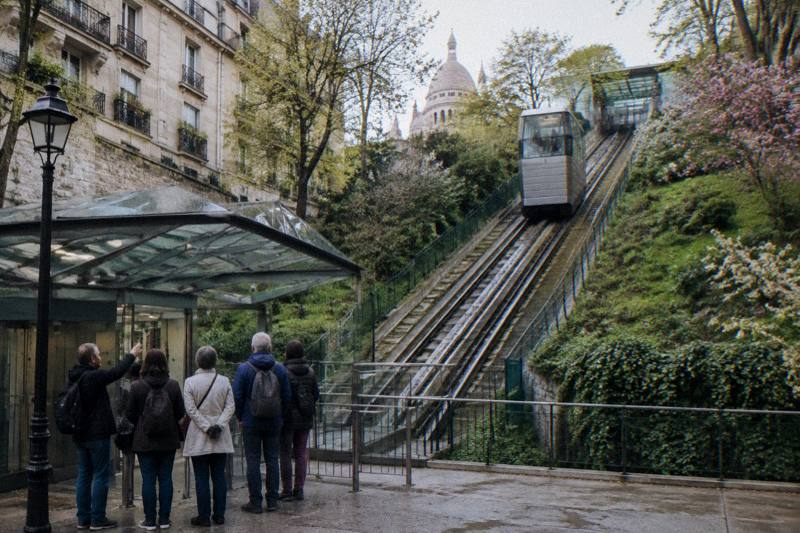
Yes, the Montmartre funicular removes the entire 222-step climb in a ride of about one minute thirty seconds. It runs seven days a week from 6am to 12:45am, costs the same as a metro ticket, and is the main shortcut for visitors who want the view without the stairs. It is operated by the RATP and connects the base of the hill near Anvers directly to the basilica parvis.
The funicular is not a tourist attraction so much as a public transport line with one stop. You board at the bottom of rue Foyatier and step out level with the parvis, which makes it the single most effective leg-saver on the hill. The Paris tourism office notes that it exists precisely to avoid the 222 steps, and it accepts the same ticket as the metro, paid by card or pass. For visitors arriving on line 2 at Anvers, the funicular entrance is a short walk from the station exit.
Two practical points are worth knowing. First, the funicular is a machine with a maintenance schedule and occasional closures, so if it matters to your plan, have the garden route as a backup. Second, the metro stations themselves involve vertical distance: Abbesses is reported to sit 36 meters below the surface, one of the deepest stations in the network, though it has four lift cabins, which the listing for the Place Saint-Pierre meeting point also notes. Anvers, the line 2 station most visitors use for the funicular, is a conventional station with stairs and escalators.
The funicular rides up but does not solve the rest of the hill. Once on top you still walk the plateau, and if your route continues down rue Lepic or toward the boulevards you will meet slopes and cobbles again. Our companion piece on whether the Montmartre funicular is worth it goes deeper on the ride itself.
What About The Cobbles, Steps And Side Streets?
The surface underfoot is the hidden difficulty in Montmartre. Most lanes are cobbled, many are stepped, and the side streets around rue Lepic and rue des Abbesses slope without warning. Firm, closed shoes with grip matter more than fitness here, and wet cobblestones after rain are the hill's most common cause of slips.
Cobblestones, or pavés, are the historic surface across most of the old village, and they are uneven by design. Heels, thin soles and smooth leather soles all struggle on them, especially on the descents where the slope pushes your weight forward. The stepped side streets, typical of the lanes between rue Lepic and the top, replace long slopes with short stone staircases, often without handrails for their full length. None of this is dangerous in the ordinary sense, but it rewards shoes with actual tread.
Rain changes the calculation. Paris averages roughly nine to eleven days with a millimeter or more of rain in the autumn months, and a wet cobbled descent is a different walk from a dry one. The lanes drain unevenly, and the steps of rue Foyatier hold water in their corners. If the forecast is wet, take the funicular up and a gentle street route down, and give the steps a wide berth.
The other underfoot factor is the crowd flow, not the stone. On busy afternoons the parvis and the top of rue Foyatier congest, and the natural instinct to overtake slows everyone into a stop-start shuffle. Early morning flips this entirely: before 10am the same streets are quiet, the light is better and the climb feels half as long. That timing logic is laid out in full in our piece on morning versus evening visits to Montmartre.
For visitors who want the lanes without the route-finding, the Paris Montmartre Walking Tour: Hidden Gems, Views & Croissant listing is relevant: a 2-hour small-group walk capped at 14, run by Intrepid Urban Adventures, meeting outside the Blanche metro, with a freshly baked croissant from an award-winning bakery included and a 4.9 rating from 1,031 reviews. It covers hidden streets and scenic stairways, so it does involve steps, but a guide chooses the gradients.
Which Tours Suit A Slower Pace?
The shorter and smaller the walk, the easier the day. The 1.5-hour Montmartre Guided Walking Tour run by Discover Walks is the shortest on the roster and the lowest price tier, while the small-group walk capped at 10 offers the most individual pace. The semi-private option on the Sacre-Coeur exclusive walk, at a maximum of 12, adds a private guide's flexibility without a private price.
Pace on a guided walk is set by two things: duration and group size. A 90-minute walk cannot wander far, so the route stays tight and the total standing-and-climbing time is bounded. The Discover Walks listing meets outside the Blanche metro exit on line 2, runs in English only, and carries a 4.8 rating from 1,028 reviews, with free cancellation. For a visitor who wants the highlights without committing their whole afternoon, it is the least demanding format on the roster.
The Montmartre Highlights Walking Tour with a Local Guide is the middle option: 2 hours 20 minutes, a small group capped at 16, meeting near the carousel at Place Saint-Pierre, which is at the foot of the Square Louise Michel gardens. It has the deepest review pool among the classic walks, 4.9 from 2,825 reviews, and a real "likely to sell out" badge, so booking ahead matters in high season. The longer duration means more of the hill, and more of the hill means more steps.
At the flexible end, the Montmartre District and Sacre Coeur Exclusive Guided Walking Tour, run by Babylon Tours Paris, is a private walk of 2.5 hours with a cheaper semi-private option capped at 12 on the same listing, meeting outside the Blanche metro and running rain or shine. It holds a 5.0 rating from 410 reviews, the highest rating on the roster, with free cancellation. A private or semi-private guide can skip a flight of steps, extend a cafe stop or reverse the route, which no fixed group walk can do.
Here is how the main options compare on the factors that determine leg-work:
| Tour | Duration | Group cap | Meeting point | Rating and reviews |
|---|---|---|---|---|
| Discover Walks guided walk | 1.5 hours | Small group | Blanche metro exit | 4.8 from 1,028 reviews |
| Small group walk with local guide | 2 hours 15 minutes | 10 | Near Blanche metro, by the Moulin Rouge | 4.9 from 576 reviews |
| Highlights walk with local guide | 2 hours 20 minutes | 16 | Near the carousel, Place Saint-Pierre | 4.9 from 2,825 reviews |
| Hidden gems walk with croissant | 2 hours | 14 | Outside Blanche metro | 4.9 from 1,031 reviews |
| Sacre-Coeur exclusive walk, semi-private | 2.5 hours | 12 | Outside Blanche metro | 5.0 from 410 reviews |
All five run in daytime slots, and all five include free cancellation except where a listing states otherwise, so a weather-based change of plan costs nothing. If you are still deciding between going alone and joining a walk, the comparison in self-guided versus guided Montmartre tours lays out the trade-offs.
How Much Walking Does A Full Montmartre Visit Involve?
A full visit that covers the basilica, Place du Tertre, the Musee de Montmartre gardens and the lanes back down typically involves two to three hours of walking, and the hill is steep enough that many visitors prefer to ride the funicular rather than climb. Splitting the visit across the funicular for the ascent and a gentle street route for the descent is the standard way to keep the total effort reasonable.
The arithmetic of the hill is simple. Going up once by stairs and coming down once by the same stairs is 222 steps each way, plus whatever the plateau adds, plus the optional 280 dome steps if you take them on top. Spread over three hours with cafe stops, that is an ordinary day of city walking with one genuinely steep section. Attempted in ninety minutes without stops, it becomes a workout, which is why pacing, not the hill itself, is the real variable.
Rest points are abundant and pleasant, which is Montmartre's saving grace. The Square Louise Michel terraces have benches on the way up, the parvis has the best free view in Paris as a standing reward, and the plateau is dense with cafes. The Musee de Montmartre, open every day from 10am to 6pm with last admission at 5:15pm, offers a gardens-only ticket that includes the view over the Clos Montmartre vineyard, a rest stop with an art-history payoff. The vineyard sits at 14 rue des Saules and is open to the public only on guided visits, so do not plan on walking through it freely.
For visitors with real stamina concerns, the honest summary is this: the hill is walkable, the funicular removes its worst feature, the dome is optional and clearly labeled as demanding, and the guided formats described above exist precisely to convert a hard solo climb into a paced, narrated stroll. Start at Blanche or Anvers, ride up, walk the plateau, and descend by rue Lepic only if your knees agree. That is the shape of a Montmartre day that leaves energy for dinner.
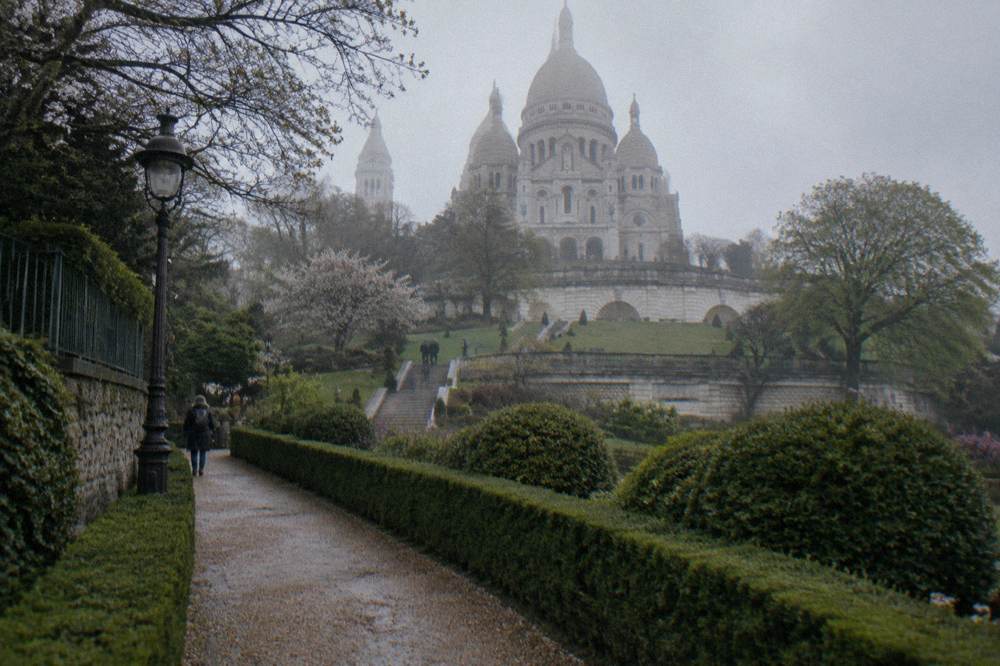
Whether you ride the funicular or take the garden stairs, the walks and the view are the same at the top, and Montmartre Paris Tours exists to help you pick the format that matches your legs and your interests. If the descriptions above have narrowed your choice, these three listings cover the pace spectrum from shortest to most flexible:
Common Questions About Walking In Montmartre
Is Montmartre Difficult To Walk?
Moderately. The hill involves 222 public steps to Sacre-Coeur, cobbled lanes and sloping streets, but the effort comes in short bursts rather than one long climb. The funicular removes the main staircase in under two minutes, and the plateau on top is comparatively gentle, so most visitors with sensible shoes and a relaxed pace manage it well.
How Many Steps Lead Up To Sacre-Coeur?
The public ascent covers 222 steps, either via the stepped rue Foyatier or through the terraced Square Louise Michel gardens, which offer benches between flights. The climb takes most people five to ten minutes. The basilica itself is free to enter and open daily from 6:30am to 10:30pm.
Is The Sacre-Coeur Dome Climb Hard?
Yes, it is the most demanding feature on the hill. The dome staircase covers 280 steps, is narrow, and has no elevator, with an official caution for anyone with mobility issues or a fear of confined spaces. Tickets are sold on site only, at 8 euros for adults and 5 euros for children up to 15, and the dome opens daily from 10:30am with last admission around 7pm.
Does The Funicular Avoid The Stairs?
Completely. The Montmartre funicular connects the base of the hill near Anvers to the basilica parvis in about one minute thirty seconds, runs seven days a week from 6am to 12:45am, and costs the same as a metro ticket. It is the standard shortcut for visitors who want the view without the 222-step climb.
Which Montmartre Tour Is Easiest On The Legs?
The 1.5-hour Montmartre Guided Walking Tour run by Discover Walks is the shortest on the roster and keeps the route tight. For a slower, more personal pace, the small-group walk capped at 10 and the semi-private Sacre-Coeur exclusive walk capped at 12 both let a guide adjust the route, and all three include free cancellation.
Are Montmartre's Cobbles A Problem?
They demand good shoes more than fitness. Most lanes are cobbled and uneven, many side streets are stepped, and wet stone after rain is the most common cause of slips. Firm, closed shoes with real grip, plus the garden route rather than rue Foyatier on wet days, keep the surface manageable.