Is The Montmartre Funicular Worth It?
A verdict on the Montmartre funicular: what it saves you, what it costs, when to ride it and when the 222 steps are the better choice.
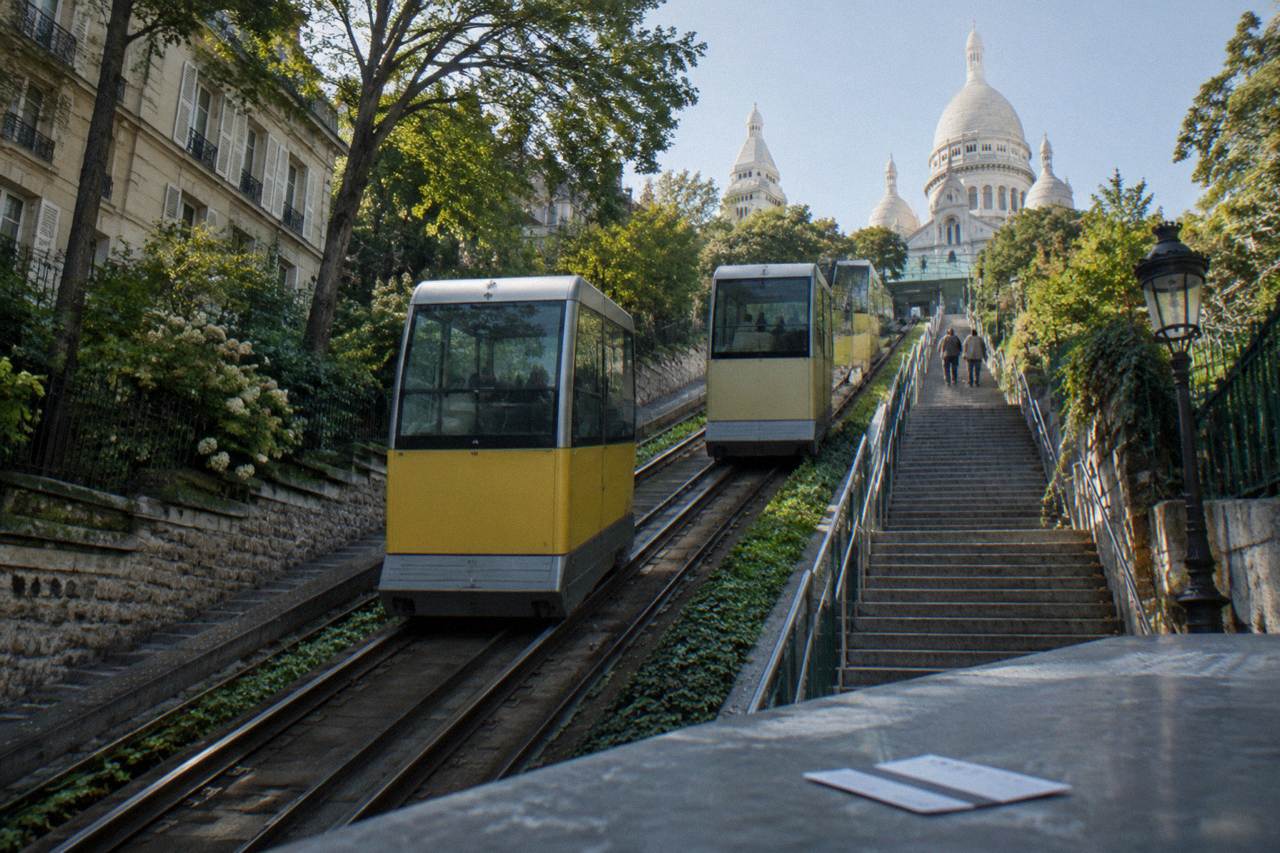
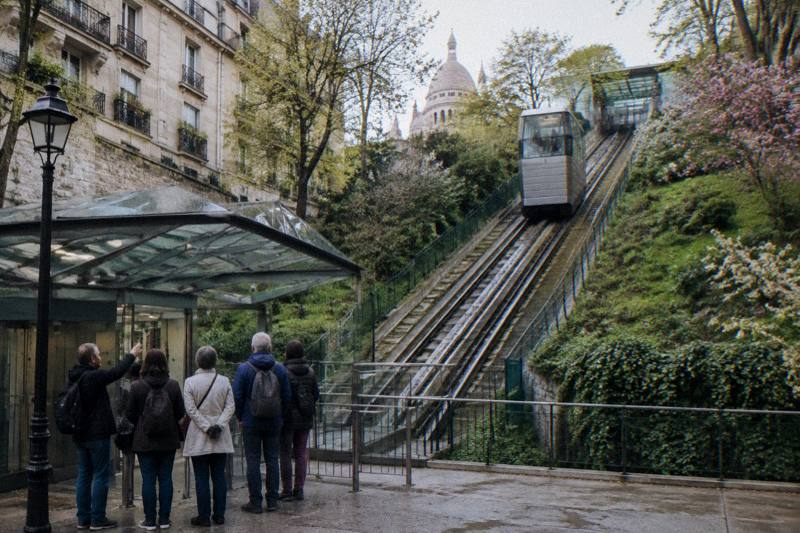
The Montmartre funicular is a 108-metre railway with one job: hauling visitors up the last steep stretch of the Butte so they do not have to climb the 222 public stairs to the Sacre-Coeur esplanade. It runs seven days a week from 6am to 12:45am, the ride takes 1 minute 30 seconds, and it is operated by RATP as part of the Paris transport network. The fare is the same as a metro ticket, and the ticket is accepted for a single trip with no transfers. Once you're up on the Butte, the Montmartre food tour guide covers what to taste and where to find it nearby.
That is the whole machine. Whether it is worth it is a question about your legs, your time of day and what you actually want from the top of the hill, and the answer is not the same for everyone.
Is The Montmartre Funicular Worth It?
Yes, for most visitors the funicular is worth it, with one clear exception. It replaces the 222-step climb with a 90-second ride, costs the same as a metro ticket, and runs from 6am to 12:45am every day of the week. The exception is the visitor who wants the climb itself: the stairs are the classic approach to Sacre-Coeur, and many guided walks use them on purpose. Once you're up there, the full cost breakdown for visiting Sacre-Coeur covers what the dome and crypt add to your budget.
The case for riding comes down to three numbers: the climb, the fare, and the wait. The public stairway up to the basilica counts 222 steps. The funicular ride lasts 1 minute 30 seconds. And it opens at 6am and closes at 12:45am, seven days a week, so it is running at almost any hour a tourist would reasonably be on the hill. The Paris tourism office page on the funicular confirms all three figures and describes it as the way to avoid the 222 steps.
The case against riding is softer but real. The stairs deliver the postcard arrival: you climb with the white domes growing in front of you, and the esplanade view opens up as a reward. The funicular, by contrast, delivers you onto the same esplanade from a cabin that is functionally a lift with windows. Photographers and walkers who have come for the atmosphere of the Butte often prefer to climb, and several of the guided walks on this site's Montmartre walking tour guide route their groups up the steps precisely because the climb is part of the story.
There is also a middle position, and it is the one we would recommend to most first-time visitors: ride up, walk down. The climb is hardest on the way up, especially in summer heat or with children in tow. Descending 222 steps is easy on the lungs and still gives you the view in reverse, the street sellers, and the slow reveal of the city below. You pay one metro-ticket fare for the ascent and spend nothing on the way down.
How Much Does The Funicular Cost And How Do You Pay?
The funicular costs the same as a single metro ticket, and that is the simplest way to put it: one ticket, one ride, up or down. It accepts the standard network ticket for a single trip up or down with no transfers, and it takes a Navigo pass. There is no special funicular ticket, because there is no such product: it is simply a metro ride that happens to go up a hill.
The operator's own fare rules are clear on the mechanics. RATP runs the funicular as part of its network, and the Ile-de-France Mobilites ticket page confirms that the t+ ticket is valid on the Montmartre funicular for a single trip, without connections to other transport. The same page details the wider ticket situation: the cardboard t+ ticket is no longer sold, remaining cardboard tickets remain accepted on the network until mid-December 2026, and the digital Navigo Easy pass has replaced them as the standard way to carry a single fare.
For a longer stay, the monthly Navigo all-zones pass runs at 90.80 euros, with a reduced rate of 45.40 euros, following the 1 January 2026 tariff update. That is a commuter product, and a short-stay visitor will usually do better with a loaded Navigo Easy card or contactless payment at the validator. The funicular takes both.
| Question | Answer |
|---|---|
| What does it cost? | The same as a single metro ticket, no separate funicular fare exists |
| What ticket is accepted? | The standard single-ride ticket, for one trip with no transfers |
| Can you use a pass? | Yes, Navigo passes work like anywhere on the network |
| When does it run? | 6am to 12:45am, seven days a week |
| How long is the ride? | 1 minute 30 seconds |
| What does it avoid? | The 222 public steps up to the basilica esplanade |
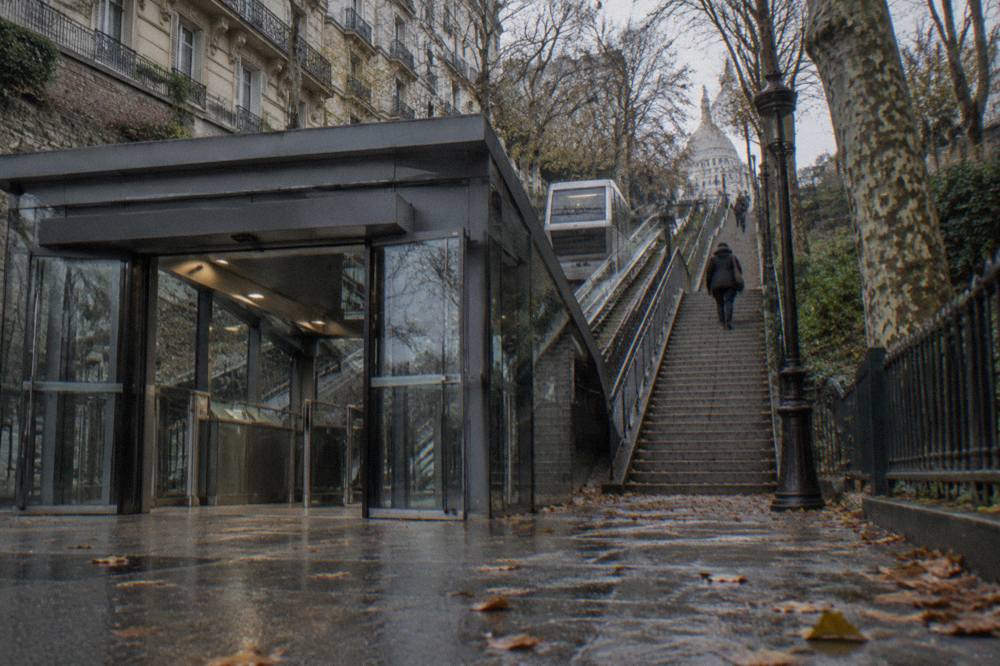
One practical note on the payment: the validators are at the station entrances like any metro station, and a family of four going up together needs four valid fares. There is no group discount and no return ticket. Budget one standard metro fare per person per direction, and treat anything beyond that as a mistake at the validator rather than a pricing tier.
When Is The Funicular The Wrong Choice?
The funicular is the wrong choice when the climb is the point of your visit, when you are on a guided walk whose route uses the stairs, or when the queue at the cabin is longer than the climb itself. It is also the wrong choice for anyone whose itinerary already puts them at the top of the hill by another route. In those cases the ride buys you nothing except 90 seconds of standing.
The guided-walk point matters more than visitors expect. The small-group walk that meets by the Moulin Rouge, the must-see walk that starts at Place Saint-Pierre, and the hidden-gems route with the croissant stop all build the stairway or the hillside lanes into their routes, because the climb is where a guide earns their keep: the story of the Commune, the vineyard on the slope, the artists' studios that line the way up. If you are on a guided walk, your ticket already includes the climb in the most interesting possible form.
The queue point is seasonal. On a busy afternoon, the line for the cabin can stretch back past the station entrance, while the stairway, though crowded, never stops moving. A fit visitor will sometimes beat the queue by simply walking up. The reverse is true at 9am on a weekday in low season, when the cabin is often near-empty and the ride is instant.
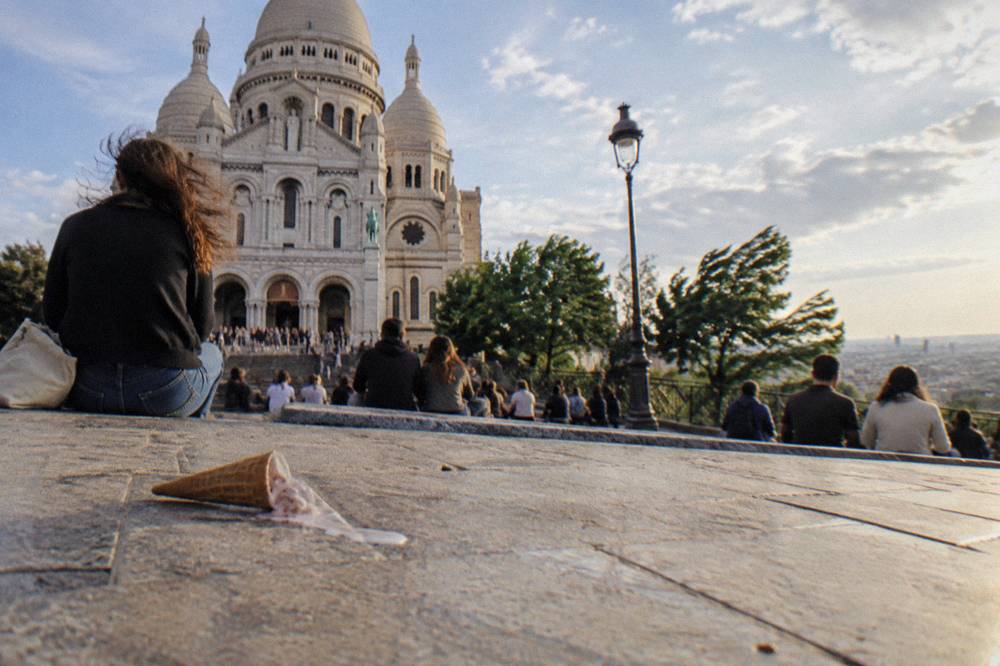
There is also the accessibility reality, which deserves plain language. The funicular is the practical step-free route to the top of the hill for anyone who cannot manage 222 stairs. The basilica itself is free and open every day from 6:30am to 10:30pm, and the dome above it is a separate, harder proposition: about 280 steps up a narrow staircase with no elevator, at 8 euros for adults and 5 euros for children to 15, tickets sold on site only. The funicular gets you to the esplanade; it does nothing for the dome, and nothing for the many staircases elsewhere in Montmartre, which is a topic covered in full in our piece on whether Montmartre is difficult to walk.
Funicular Or Stairs: The Verdict By Visitor Type
For anyone with knee, heart, or mobility concerns, the funicular is the clear choice: it is the only step-free route to the esplanade. Families with small children should ride up but can skip it coming down. Fit adults on a first visit get the better experience taking the stairs up, and photographers and guided-walk participants should do the same, since the climb itself is the shot and the route already includes it.
The verdict table below compresses the whole question into visitor types. It assumes a standard visit, arriving from the bottom of the hill near the Anvers or Blanche metro stations.
| Visitor type | Ride or climb | Why |
|---|---|---|
| Limited mobility | Ride, both ways | The funicular is the practical step-free route to the esplanade |
| Families with young children | Ride up, walk down | The climb is the hard half; descending is easy and free |
| Fit first-time visitor | Climb up, ride or walk down | The stairway arrival is the classic Montmartre experience |
| Photographer | Climb | The stairway and the hillside lanes carry the best light and views |
| Visitor on a guided walk | Follow the route | The walks build the climb in deliberately, with the commentary |
| Anyone at the end of a long day | Ride | 222 steps after a full day of Paris walking is a real cost |
One pattern is worth pulling out of the table: the funicular's value rises with fatigue. Montmartre is a hill of staircases and lanes, and most visitors reach it late in a day that already included several kilometres of walking. The 222 steps are not dangerous, but they arrive at the exact moment a tired traveller least wants them. That, more than any engineering fact, is why the little railway keeps climbing the hill, cabin after cabin.
What The Funicular Does Not Solve
The funicular solves exactly one problem: the 222 steps between the bottom of the hill and the basilica esplanade. It does not help with the staircases and sloping lanes that cover the rest of Montmartre, it does not reach the dome of Sacre-Coeur, and it does not connect to anything at the top beyond the esplanade itself. Visitors who imagine it as a hill-wide people mover will be disappointed: it is a 108-metre shuttle with two stations.
The rest of the hill is genuinely steep, and that is a separate question from the funicular. Rue Lepic climbs in zigzags toward the Moulin de la Galette. The lanes around the Clos Montmartre vineyard and the Musee de Montmartre slope and step without warning. The museum itself, at 12 rue Cortot, is open every day from 10am to 6pm, with full-price entry at 16 euros during the exhibition period, and its gardens look out over the vineyard, but getting there from the basilica involves a downhill walk that becomes an uphill walk on the return.
The vineyard has its own access rule, which the funicular cannot change: the Clos Montmartre is open to the public on guided visits only, a rule stated by the Ville de Paris on its own page for the site. During the Fete des Vendanges, the 93rd edition of which runs 7 to 11 October 2026, guided vineyard visits require booking and several slots fill well in advance. Our Montmartre vineyard and wine tour guide covers how those visits work and what the festival adds.
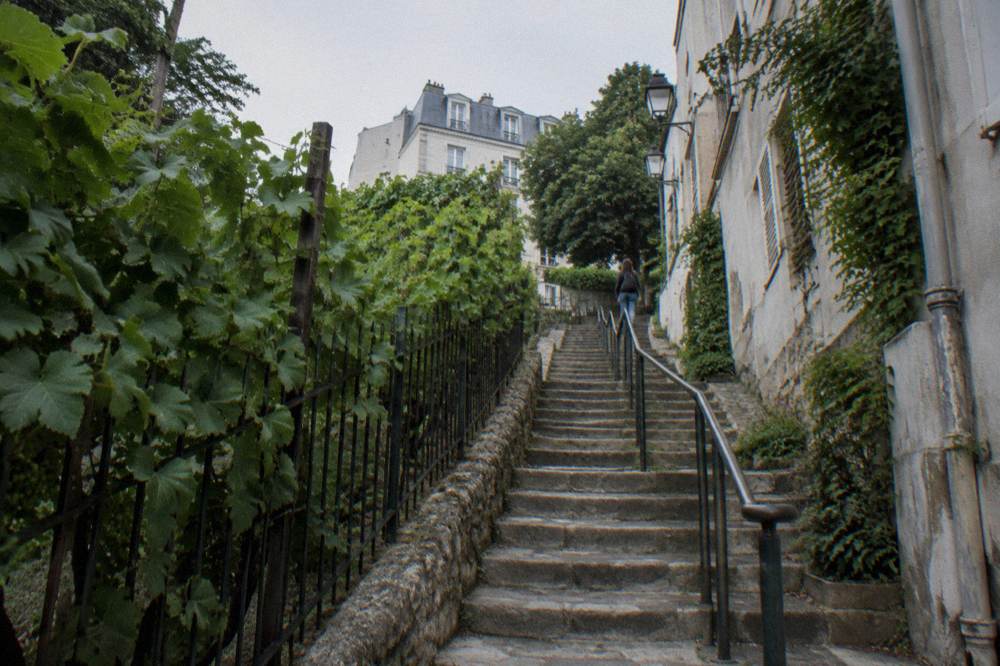
The dome is the other thing the funicular cannot touch. Even after the ride, the dome's 280-step spiral staircase, with no elevator and a warning against it for anyone with mobility issues or a fear of confined spaces, is the only way to the best view in Paris. The official dome page sets out the conditions plainly, including the midday staff break and the weather-dependent closures. A visitor who manages the funicular but not the dome has still seen the free basilica and the esplanade view, which is a fair outcome.
How The Funicular Fits Into A Tour Day
The funicular fits best at the end of a tour, not the start. Most guided walks on the hill begin at the bottom, at the Blanche or Anvers metro stations, and climb as part of the route, which means the natural moment to ride is the return trip after the walk ends near the basilica. The exception is the visitor starting a self-guided day at the top, for whom the ride up is the sensible opening move.
Consider how the actual tours are shaped. The must-see walk meets at Place Saint-Pierre at the foot of the hill, in front of Cafe Le Ronsard, and works upward. The highlights walk with the deepest review pool on the roster, 4.9 from 2,825 reviews, meets near the carousel at Place Saint-Pierre, the same low starting point. The Discover Walks route, the shortest at 1.5 hours, starts outside the Blanche metro exit. All of them climb on foot, because the climb is where the neighbourhood is.
The return trip is where the funicular quietly wins. After two hours on the hill, the descent is the part of the day that hurts the next morning, and the ride down costs one metro fare and takes 90 seconds. Tour-goers who ride down rather than walk down lose nothing of the visit, since the arrival view is already behind them, and the station at the bottom sits right beside the onward transport links.
The self-guided visitor has the mirror-image choice. Starting at the top, by riding up first thing, front-loads the easy part and leaves the whole hill to descend at leisure, through the museum, the vineyard lanes and Place du Tertre. That order suits anyone who wants the basilica view in the morning light before the esplanade fills up. The morning-versus-evening question has its own full treatment in our article on whether to visit Montmartre in the morning or evening, and the funicular runs at both ends of the day, so the ride itself never dictates the timing.
The Short History, And Why It Exists
The funicular opened in 1900, the year of the Paris Exposition Universelle, and it has been rebuilt twice since, in 1935 and 1991. Its purpose has never changed: the Butte Montmartre is the highest point in Paris, the basilica on its summit welcomes visitors daily from early morning until late evening, and the 222 steps were, from the beginning, a barrier the city chose to mechanise. The current installation runs two automatic cabins on the 108-metre track, covering a rise of 36 metres.
The 1900 opening date puts the funicular in the same era as the Paris metro itself, and it has always been treated as transport rather than an attraction. That is the useful frame for the worth-it question: nobody asks whether a bus is worth it. The funicular is a bus that goes vertically, priced like one, run by the same operator, and judged by the same standard, which is whether it takes you where you were going with less effort.
It is also, quietly, a piece of the hill's character. The two cabins sliding past each other on the slope, the station at the bottom buzzing with tour groups, the exit onto the esplanade with the city spread below: this is the machinery of Montmartre as it has been for more than a century. Montmartre Paris Tours covers the hill's walks and landmarks across the site, and the funicular appears in nearly every itinerary for one simple reason, which is that it works.
Common Questions About The Montmartre Funicular
Is The Montmartre Funicular Worth It?
For most visitors, yes. It replaces the 222-step climb with a 90-second ride, costs the same as a metro ticket, and runs from 6am to 12:45am every day. Fit visitors who want the classic stairway arrival should climb up and can ride down. Visitors with mobility concerns should ride in both directions.
How much does the Montmartre funicular cost?
The fare is the same as a single metro ticket, and the standard network ticket is accepted for one trip with no transfers. There is no separate funicular ticket and no published special fare, so budget one metro fare per person per direction.
What are the funicular's opening hours?
It runs seven days a week from 6am to 12:45am. The ride takes 1 minute 30 seconds. Hours can be affected by maintenance, so a visit planned around the last ride of the evening should allow some margin.
Does the funicular go to the top of Sacre-Coeur?
It goes to the basilica esplanade, which is the level of the main entrance. The dome above the basilica is a separate climb of about 280 steps with no elevator, at 8 euros for adults and 5 euros for children to 15, tickets on site only.
Can I use a Navigo pass on the funicular?
Yes. The funicular is operated by RATP as part of the Paris network, and Navigo passes are accepted the same way as on the metro. A single-ride ticket also works, for one trip without transfers.
Is the funicular step-free and accessible?
It is the practical step-free route to the basilica esplanade, avoiding the 222 public stairs. It does not remove the steps elsewhere in Montmartre, which remains a neighbourhood of slopes and staircases, nor the dome's spiral staircase inside the basilica.