Montmartre Funicular, Metro And How To Reach The Hill
The funicular lifts you the 36 vertical metres from the street to the basilica forecourt in ninety seconds, and it costs the same as a metro ticket. Here is how it works, which stations the tours actually use, and when the 222 steps are the better choice.
Short answer
The Montmartre funicular is operated by RATP, runs every day from 6am to 12:45am, and costs the price of a metro ticket. The ride takes 1 minute 30 seconds and avoids the 222 public stairs. The three metro stations the tours use are Blanche and Anvers on line 2, and Abbesses on line 12.
Montmartre Funicular, Metro And How To Reach The Hill
The Butte Montmartre is the highest point in Paris, and everything about visiting it flows from that one fact. The basilica sits at an altitude of roughly 130 metres above sea level, the streets around it tilt and stack, and the standard approach from the south finishes with a wall of 222 stone steps rising from Place Saint-Pierre to the Sacre-Coeur forecourt. Most visitors arrive by metro, and the metro does the horizontal part of the journey well. The vertical part is where the planning happens, and it comes down to a short, steep funicular railway, a long staircase, or a walking route that climbs more gently from a different side of the hill.
This guide lays out every option with the numbers that matter. It covers how the funicular works and what a ticket costs, which stations the guided walks actually use as meeting points, how the 222 steps compare on effort, and how a tour changes the arithmetic of the climb. The hidden-gems small-group walk, the highlights walk that starts near the carousel at Place Saint-Pierre, and the short Discover Walks tour all begin at the bottom of the hill, so the access question is the first decision of the day, not an afterthought.
How Does The Montmartre Funicular Work?
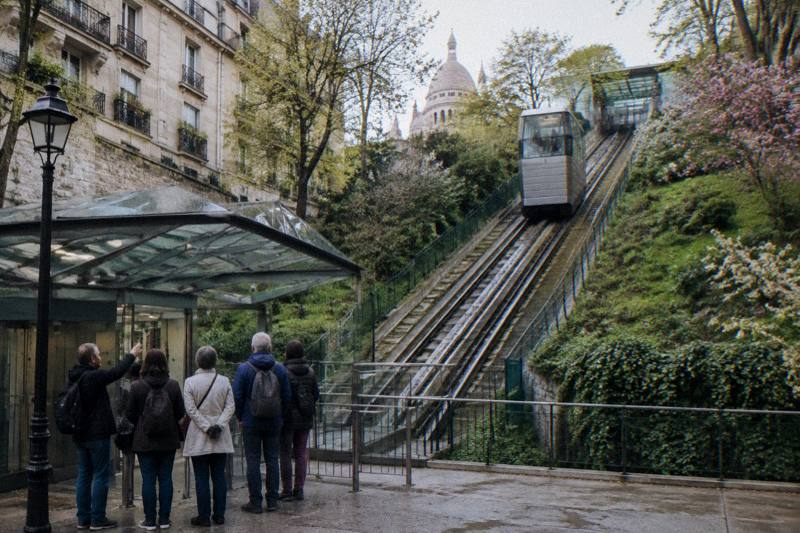
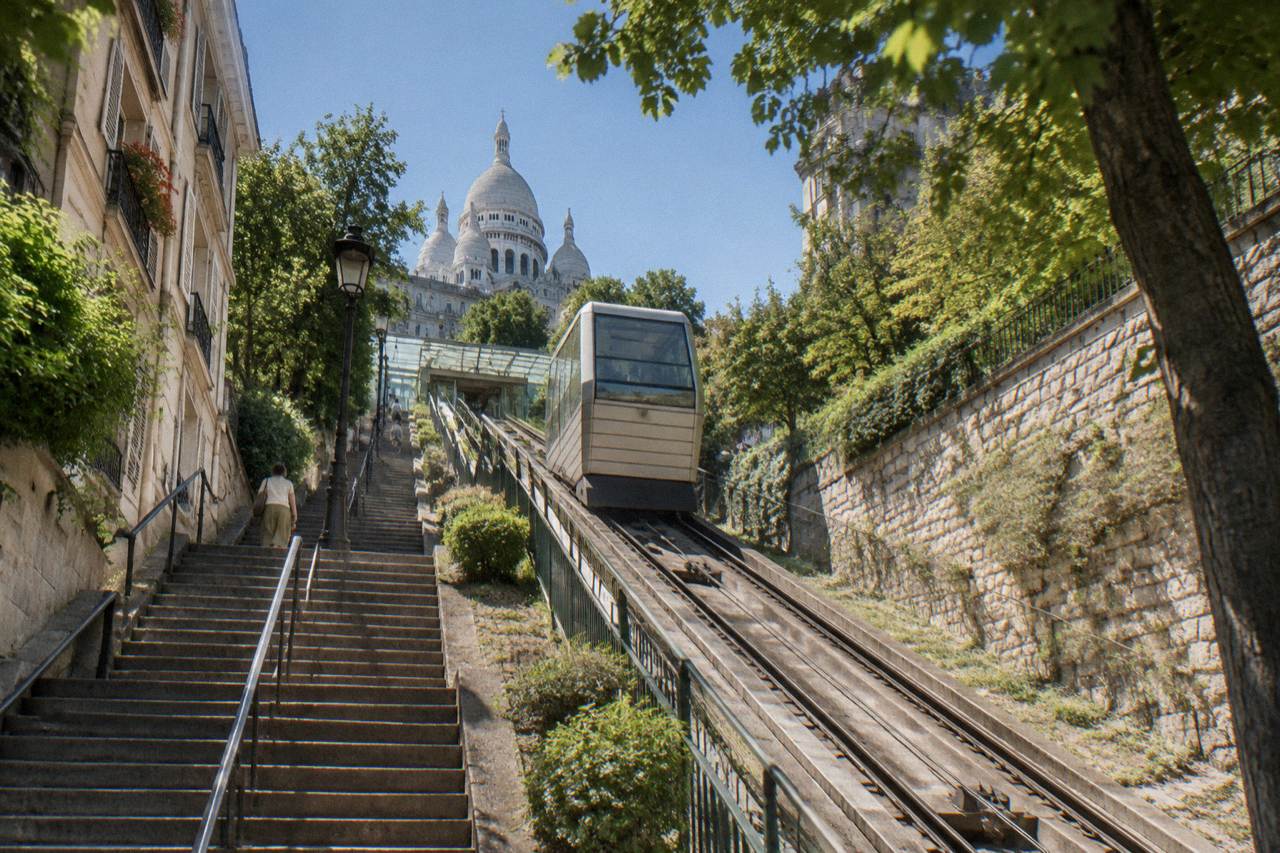
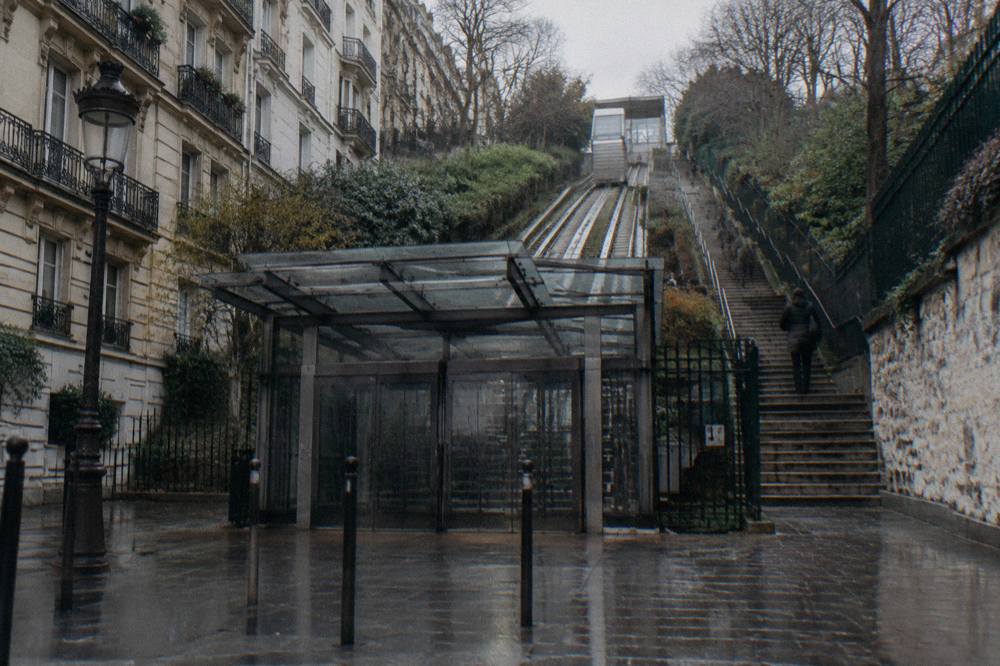
The Montmartre funicular is a short inclined railway operated by RATP that connects the south end of Rue Foyatier, near Place Saint-Pierre, with the Sacre-Coeur forecourt above. It opened in 1900, runs every day from 6am to 12:45am, and carries passengers up or down in about 1 minute 30 seconds, replacing a climb of 222 steps.
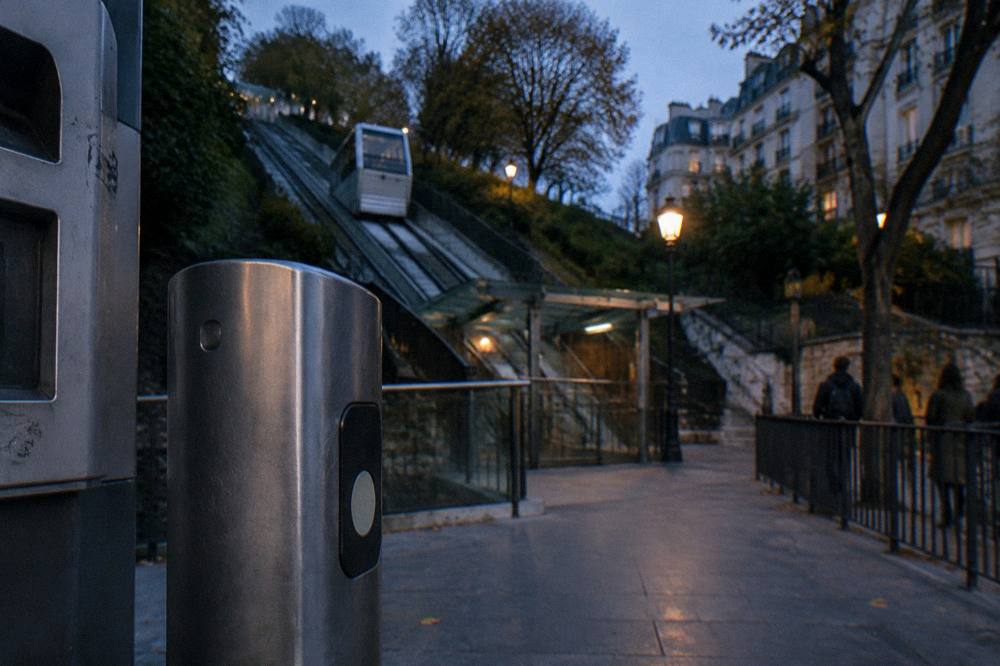
The line is tiny by railway standards, 108 metres long with a rise of 36 metres, and it was rebuilt twice, in 1935 and 1991, which is why today's version runs automatic cabins rather than the original funicular machinery. Two cabins run in opposite directions on parallel tracks, counterbalancing each other, and the ride is over almost before it registers. You board at the bottom, the doors close, the cabin tilts up the slope, and ninety seconds later you step out level with the basilica esplanade. There is no scenic suspense, and that is the point: the funicular exists to move people up a hill that would otherwise filter out anyone with tired legs, a stroller, or a knee that objects to staircases.
Because it is operated by RATP, the same body that runs the Paris metro, it behaves like part of the transit network. The same ticket types work, the same passes work, and the operating hours are transit hours rather than attraction hours: 6am to 12:45am, seven days a week. That early start matters if you want the esplanade before the crowds, because the basilica itself opens at 6:30am and the funicular is running before that. The trade-off is equally simple to state. The ride is enclosed, brief, and delivers you into the busiest corner of the summit, whereas the stairs next to it give you the view unfolding step by step and cost nothing but effort.
One thing the funicular is not: a tour. It has no commentary, no stops, and no route through the village streets. If the goal is to understand Montmartre rather than simply stand on it, a guided walk does that work, and the climb becomes a segment of a route rather than an obstacle. The Montmartre walking tour guide on this site covers what those walks include in detail.
How Much Do Montmartre Funicular Tickets Cost?
A single funicular ride costs the same as a metro ticket, and it is paid with the same ticket or pass you would use on the metro. There is no separate funicular fare structure, no round-trip product, and no discount card specific to the railway. A ticket covers one trip, up or down, without onward connections.
That flat equivalence is the whole pricing story, and it is worth being precise about what it means in practice. You tap or validate the same ticket you used to reach the neighborhood, or you buy one at the machines in the connecting metro stations, and the funicular accepts it for a single trip. Because the fare is pegged to the standard single-ride ticket, anything that changes the metro ticket price changes the funicular price with it, which is why this guide does not print a euro figure: the fare moves with the transit tariff, and the tariff is set annually by the regional transport authority. The operator's own pages carry the current number, and the funicular payment page on the RATP site confirms the payment methods accepted at the validators.
The practical mechanics are friendlier than the fare theory. Contactless bank cards work at the funicular validators, so a visitor who has just landed can ride without first hunting down a ticket machine, and the validators handle multi-validation for small groups travelling together on one card. For a family of four, that means four taps of the same card rather than four separate tickets. Navigo Easy, the digital card that replaced the cardboard ticket, carries stored tickets and passes and works at the same readers.
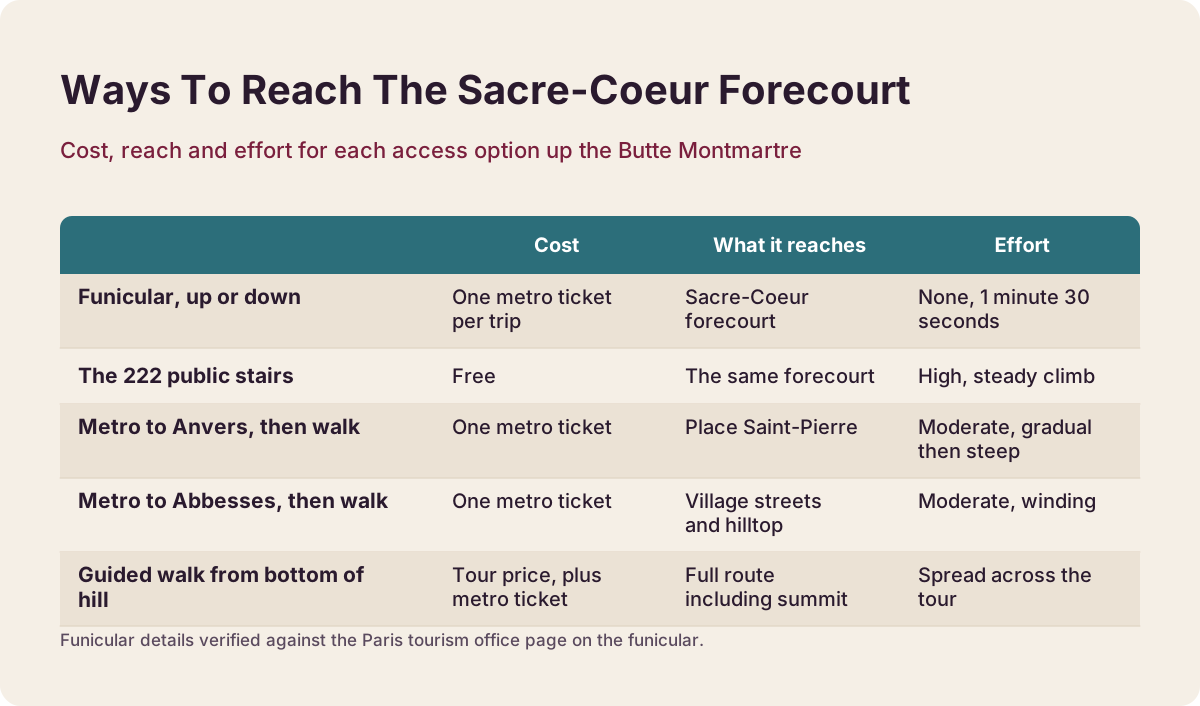
| Access option | Cost basis | What it reaches | Effort |
|---|---|---|---|
| Funicular, up or down | One metro ticket per trip, per person | Sacre-Coeur forecourt from Place Saint-Pierre | None, 1 minute 30 seconds |
| The 222 public stairs | Free | The same forecourt, alongside the funicular | High, steady climb |
| Metro to Anvers, then walk | One metro ticket | Place Saint-Pierre via Rue de Steinkerque, a shop-lined climb | Moderate, gradual then steep |
| Metro to Abbesses, then walk | One metro ticket | The village streets and the hilltop via gentler lanes | Moderate, winding |
| Guided walk from a bottom-of-hill meeting point | Tour price, metro ticket to get there | The full route including the summit | Spread across the tour |
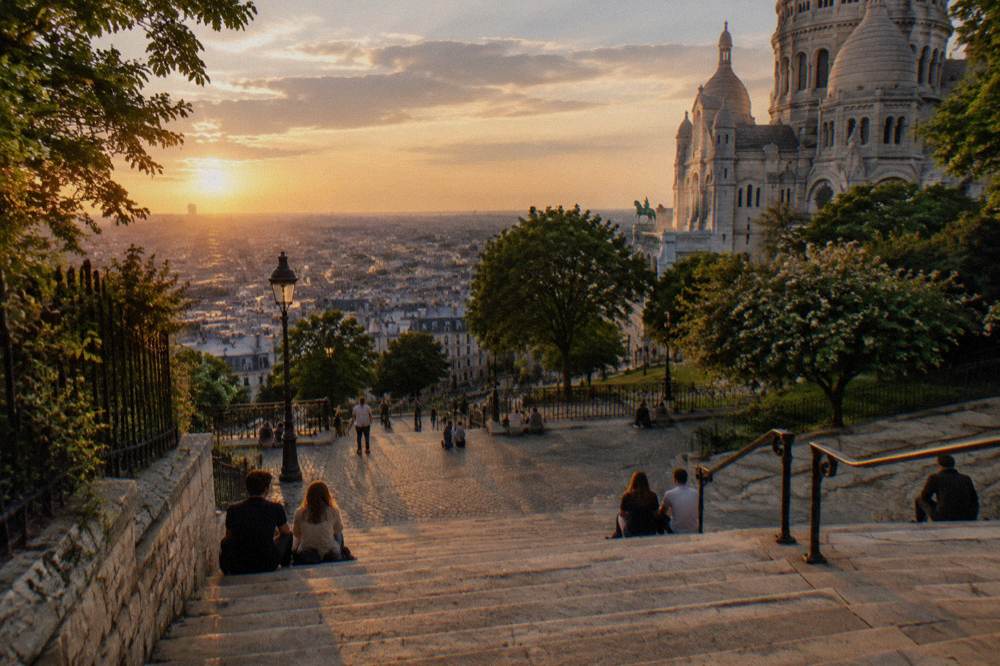
The stairs deserve their own line in that table because they are not a consolation prize. They run beside the funicular in a long, straight cascade, and on a clear evening they are one of the better free experiences in Paris, each step adding height and city to the view behind you. The trade is honest: free, no queue at a validator, and a genuine climb that many visitors prefer to have done rather than skipped. For anyone weighing whether the ride justifies its ticket at all, the is the Montmartre funicular worth it post works through the decision in detail.
If the climb itself is the part you are dreading rather than the fare, the honest answer is that a guided walk reframes it. The three listings below all start at the bottom of the hill and pace the ascent with stops, so the 222 steps become one segment of a route rather than a wall you face alone.
Which Metro Stations Get You To Montmartre?
Three stations serve the meeting points used by the tours on this roster: Blanche and Anvers on metro line 2, and Abbesses on line 12. Blanche sits at the foot of Boulevard de Clichy by the Moulin Rouge, Anvers is the closest stop to the basilica approach, and Abbesses is the deep station inside the village streets.
Blanche is the workhorse. The Moulin Rouge stands at 82 Boulevard de Clichy directly opposite the station exit, and several of the roster's guided walks use it as a meeting point, including the hidden-gems walk that gathers outside the Blanche exit at ground level and the small-group walk that assembles nearby by the Moulin Rouge. Line 2 runs east to west across the north of Paris, and Blanche is a straightforward ride from the west or a connection away from most central starting points. From the platform to the street, the exit puts you on the boulevard with the hill visible to your north-east.
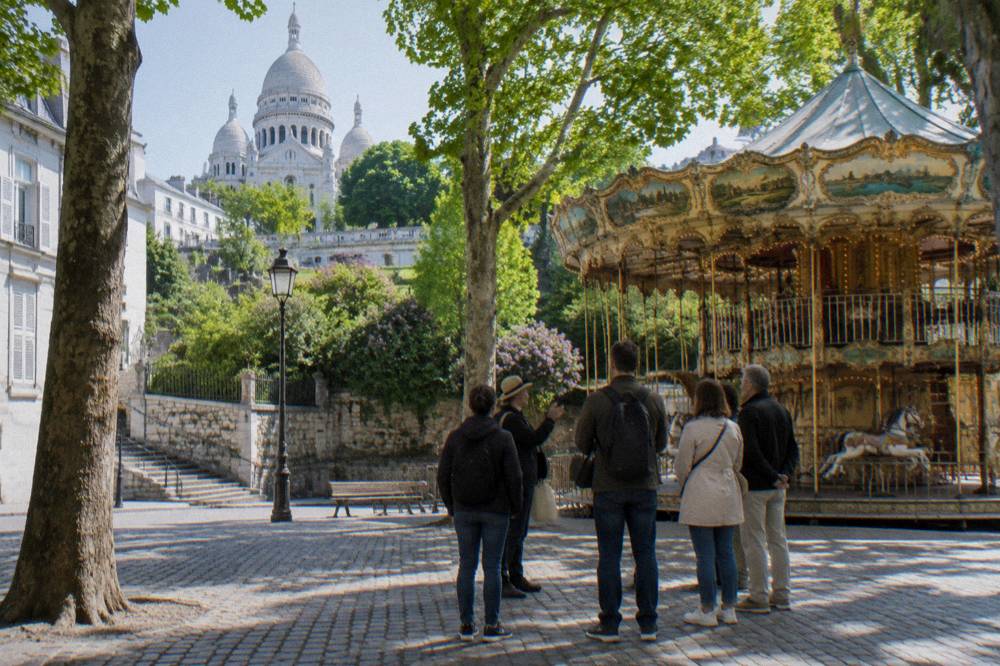
Anvers is the basilica station. It is also on line 2, one stop east of Blanche, and it serves the classic approach: out of the station, along the shop-lined Rue de Steinkerque, and up to Place Saint-Pierre where the stairs and the funicular begin. The ten-tastings food tour meets at Anvers on weekdays, and the carousel at Place Saint-Pierre, where the highlights walking tour gathers, is the natural landmark at the top of that approach. Anvers is also the station for the Sacre-Coeur itself if you are going up independently.
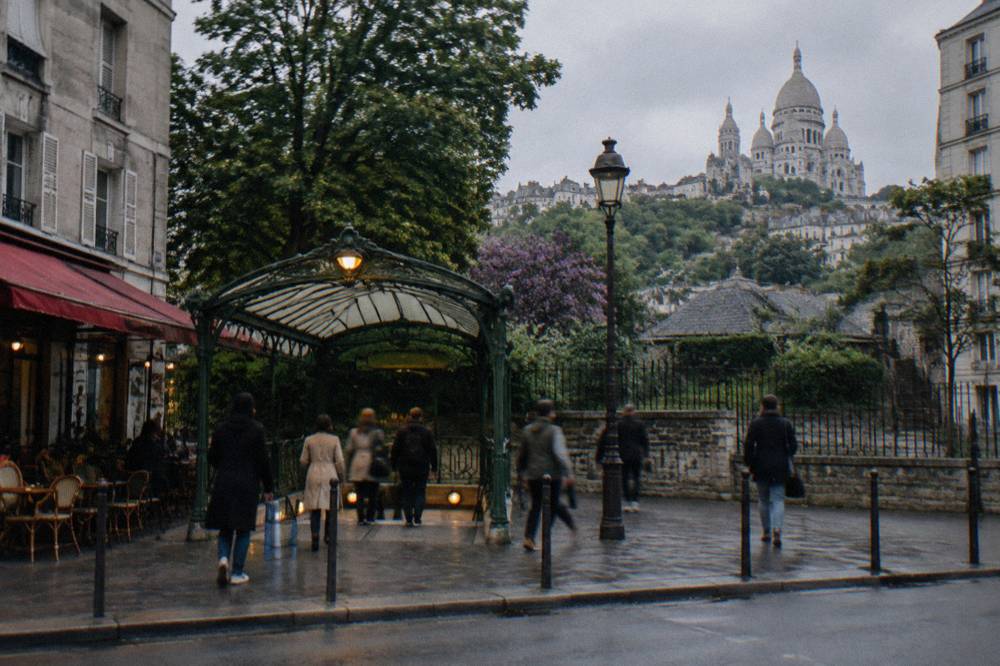
Abbesses is the village station, on line 12, and it is a different animal. Its platforms sit 36 metres below the surface, the deepest on its line and historically the deepest in the network, and the station has four lift cabins plus a spiral stair for anyone who prefers steps. The single entrance sits under a Guimard glass canopy on Place des Abbesses, and the Wall of Love is in the square beside it. The ten-tastings food tour uses Abbesses at weekends, and the eating tour meets on Rue Lepic, which climbs from that side of the hill.
| Station | Line | What you find at street level | Roster meeting points it serves |
|---|---|---|---|
| Blanche | Line 2 | Boulevard de Clichy, the Moulin Rouge at 82 Boulevard de Clichy | Hidden-gems walk, small-group walk, street art tour, Sacre-Coeur focused walks, private croissant tour |
| Anvers | Line 2 | Rue de Steinkerque approach, Place Saint-Pierre, carousel | Highlights walk near the carousel, ten-tastings food tour on weekdays, private food tour on weekdays |
| Abbesses | Line 12 | Place des Abbesses, Wall of Love, village lanes | Ten-tastings food tour at weekends, private food tour on other schedules, eating tour on Rue Lepic nearby |
A note on the other stations that appear on maps of the hill: only Blanche, Anvers and Abbesses are confirmed here against official transport pages and the meeting-point details given in the tour listings, so no others are named as fact. Any station will get you to the neighborhood, but the three above are the ones the tours actually use, and planning around them removes the guesswork from the first ten minutes of any booked walk.
If arriving by metro and then climbing sounds like two decisions, a walking tour collapses them into one. The hidden-gems small-group walk meets you outside the Blanche exit and threads the hidden streets and scenic stairways upward, ending at the panoramic views, with a fresh croissant from an award-winning bakery along the way.
Should You Take The Funicular Or Climb The 222 Steps?
Take the funicular if the priority is the summit with minimum effort, if anyone in the group has mobility or stamina concerns, or if you are descending at the end of a long day. Take the stairs if the climb itself is part of the visit, if the queue at the validators is long, or if you want the view to build gradually. The stairs are free, the funicular costs one metro ticket per person.
The stairs are the original answer to this question and they have not changed. There are 222 of them, verified against the Paris tourism office's own page on the funicular, and they rise from Place Saint-Pierre to the esplanade in a single sustained flight with landings. In cool weather, at an unhurried pace with a photo stop or three, the climb takes most people ten to fifteen minutes. In July heat with a stroller, it is a different proposition, and the funicular's ninety seconds start to look like the reasonable choice rather than the lazy one.
The funicular's honest weaknesses are the queue and the enclosure. On a busy afternoon the boarding area at the bottom fills with tour groups, and the wait can exceed the climb time. The cabins are enclosed, so the ride itself shows you almost nothing: the view payoff is instant but only begins once you step out. The stairs deliver the opposite experience, a slow reveal with the city opening behind you on every landing, and they never have a queue.
There is a third answer that this site's tour roster makes possible: approach from a different side and let a route do the climbing. The village streets north and west of the basilica rise more gently, in short flights and sloping lanes, which is why several walks start at Blanche or in front of the Saint-Jean de Montmartre church and arrive at the top through Rue Lepic and the quieter lanes rather than up the main staircase. If the 222 steps are the part of Montmartre you would rather not do, a guided route that distributes the climb is the fix, and the is Montmartre difficult to walk post grades the hill's terrain street by street.
| Factor | Funicular | The 222 stairs | Guided walk from below |
|---|---|---|---|
| Time, bottom to top | 1 minute 30 seconds | Roughly 10 to 15 minutes at a steady pace | Spread across the tour, 1.5 to 3 hours total |
| Cost basis | One metro ticket per person per trip | Free | Tour price plus your metro ticket to the meeting point |
| Effort | None | A sustained 222-step climb | Moderate, broken into segments with stops |
| View during the climb | Enclosed, none | Builds step by step | Route-dependent, includes side streets |
| Best for | Tired legs, descent, tight schedules | Clear evenings, photographers, free access | First visits, anyone wanting context |
One planning detail worth knowing before you choose: the funicular's long hours, 6am to 12:45am, mean it runs well after dark, which matters for the descent. The basilica esplanade stays populated into the evening, and going down by funicular after sunset avoids repeating a steep, busy staircase in the dark. The can you walk around Montmartre at night post covers the after-dark side of the hill, including the fact that the roster's guided walks run in daytime slots unless a listing states an evening departure, so check departure times on the listing for your date.
Where Do Montmartre Walking Tours Meet?
Most guided walks on this roster start at the bottom of the hill, at street level by a named metro station: Blanche for many, Place Saint-Pierre near the carousel for the highlights walk, and the church of Saint-Jean de Montmartre for the art, culture and food walk. Others meet at the cemetery, Anvers, Abbesses or Rue Lepic. None of them meets at the top, so your metro ticket gets you to the start and the tour handles the climb.
The meeting points are not arbitrary. They sit where the hill's geography begins, which means the walk to the summit is part of the product. The highlights walking tour, rated 4.9 from 2,825 reviews, meets near the carousel at Place Saint-Pierre, at the exact foot of the stairs and funicular, and runs 2 hours 20 minutes in a small group capped at 16. The Discover Walks guided tour, 4.8 from 1,028 reviews, meets outside the Blanche metro exit and covers the hill in 1.5 hours, the shortest walk on the roster. The hidden-gems small-group walk, 4.9 from 1,031 reviews, also meets at Blanche, at ground level, and spends its 2 hours on the hidden streets and stairways that the main approach skips. The rest of the planning pages sit on Montmartre Paris Tours.
The small-group walk capped at 10, the smallest cap on the roster, meets near the Blanche exit by the Moulin Rouge and carries a real "likely to sell out" badge, as do the highlights and must-see walks. Those badges are worth taking seriously on this hill: the meeting points are compact, the groups are small by design, and the walks that carry them fill first in peak season.
| Tour | Rating and reviews | Duration | Meeting point | Group cap |
|---|---|---|---|---|
| Highlights walking tour | 4.9 from 2,825 reviews | 2 hours 20 minutes | Near the carousel, Place Saint-Pierre | 16 |
| Must-see walking tour | 4.9 from 896 reviews | 2 hours 30 minutes | Place Saint-Pierre, in front of Cafe Le Ronsard | Small group |
| Discover Walks guided tour | 4.8 from 1,028 reviews | 1.5 hours | Outside the Blanche metro exit | Small group |
| Small-group walking tour | 4.9 from 576 reviews | 2 hours 15 minutes | Near the Blanche metro exit, by the Moulin Rouge | 10 |
| Hidden-gems small-group walk | 4.9 from 1,031 reviews | 2 hours | Outside the Blanche metro, ground level | 14 |
For the logistics of the day, the pattern to notice is that Blanche and Place Saint-Pierre between them anchor almost every classic walk. A visitor staying anywhere on line 2 can reach either without a connection, and the two points are one metro stop apart, so a backup plan costs nothing: if you miss one meeting point, the other is a minute away by train or a short walk along the boulevard. The where should I start my walk in Montmartre post builds on this for self-guided visitors who want the same logic without a booked group.
The small-group walk capped at 10 is the one that rewards booking ahead most directly, since ten places on a hill that receives visitors by the thousands is a narrow door.
Do You Still Need The Funicular If You Take A Guided Walk?
Usually not. The guided walks climb the hill as part of their routes, using gentler lanes and stairways rather than the main 222-step flight, and they end at or near the top. You need a metro ticket to reach the meeting point, but the funicular becomes optional: a convenience for the descent, not a necessity for the ascent.
This is the quiet financial argument for a tour that most visitors only notice afterwards. The walks do the climbing inside the product you already paid for. The art, culture and food walk run by ExperienceFirst, 4.9 from 2,874 reviews, the deepest review pool on the whole roster, starts in front of the Saint-Jean de Montmartre church and covers the hill in 90 minutes, with an optional wine and cheese tasting at a historic restaurant for those who upgrade. The Sacre-Coeur focused walk run by My Super Tour, 4.9 from 249 reviews, meets outside the only access to the Blanche metro where the guide holds a yellow sign, and spends its 2 hours on the bohemian streets and the basilica.
Neither of those routes queues at a funicular validator. The hidden-gems walk states its inclusions plainly: a freshly baked croissant from an award-winning bakery, hidden streets and scenic stairways, panoramic views, and a passing look at the Moulin Rouge, Sacre-Coeur and the vineyard, with an English-speaking guide. The stairways in that list are the hill's back routes, the ones residents use, and a guide who knows them turns the climb into content. That is the walk this site features alongside this guide, and it is the one that most directly answers the question of how to get up the hill without the climb being a chore.
The funicular still earns its ticket in two scenarios. The first is the descent: after a 2 or 3 hour walk that ends on the esplanade, the ride down to Place Saint-Pierre saves the knees exactly when they need saving. The second is the pre-tour arrival: if your walk meets at the top end of the hill or you want time on the esplanade before the meeting time, a ride up buys you that margin.
The art, culture and food walk below is the mid-tier option that pairs well with this logic: a short, dense route that starts low and finishes high.
For visitors whose priority is the basilica itself rather than the village, the dedicated walk that pairs the bohemian streets with the Sacre-Coeur covers the monument with a guide and leaves the funicular out of the equation entirely.
What About Navigo Passes And The Paper Ticket Phase-Out?
A Navigo monthly all-zones pass costs 90.80 euros, or 45.40 euros at the reduced rate, and covers the funicular like any other mode. Cardboard single tickets are no longer sold since November 2025, and remaining paper tickets are accepted on the metro and RER until 14 December 2026, with exchanges possible into January 2027. Contactless bank card payment works at the funicular validators.
The pass question matters on this hill more than elsewhere because the funicular is a paid mode that pass-holders ride for free, effectively. A visitor with a Navigo monthly pass taps through the funicular validators exactly as they would tap into a metro platform, no separate ticket, no thought required. For a week-long stay the monthly pass may be more than needed, and the 2026 tariff page on the regional transport authority's site lists the full range of passes and fares for anyone doing that math, including the reduced rates.
The paper ticket phase-out is the detail that catches returning visitors. The cardboard single ticket, a Paris object for over a century, left the machines in November 2025, and the network is in a transition window: remaining cardboard tickets still validate on the metro and RER until 14 December 2026, and they can be exchanged at RATP or SNCF counters until 14 January 2027. The digital replacement is Navigo Easy, a rechargeable card that carries single tickets and passes, and it works on the funicular. The transport authority's transition page sets out the dates.
For a one-day visitor the practical translation is simple. Arrive, tap a contactless bank card at the metro, tap the same card at the funicular if you choose it, and be done with ticketing. The multi-validation feature at the funicular validators handles up to four passengers on one card, which covers most family groups in a single tap sequence. The only trap left is holding a cardboard ticket bought before November 2025: it still works through the transition window, but plan to spend it before mid-December 2026 or exchange it.
How Should You Plan The Whole Journey To The Hill?
Plan it in three legs: one metro ticket to Blanche, Anvers or Abbesses depending on your meeting point or entry route, one decision at the bottom between the funicular and the stairs, and one descent that the funicular's late hours make easy. If you book a guided walk, the middle leg disappears into the tour and only the metro leg remains.
The order of decisions matters because the first one, which station, determines the character of the visit. Anvers delivers the classic postcard approach up Rue de Steinkerque to the stairs. Blanche starts at the Moulin Rouge, created 1889 at 82 Boulevard de Clichy, and delivers the cabaret-to-basilica arc that most guided walks use. Abbesses drops you inside the village, 36 metres below street level to begin with, and the hill unfolds from there through lanes rather than staircases. Each station is one metro ticket away from the others, so a wrong choice costs a minute, not a morning.
The basilica at the top is free and open every day from 6:30am to 10:30pm, which anchors the timing. The dome costs extra, 8 euros for adults and 5 euros for children to 15, tickets sold on site only, and its 280 steps are a second, optional climb that no funicular assists: the dome staircase is narrow, has no elevator, and is not recommended for anyone with mobility issues or a fear of confined spaces. Anyone budgeting effort for the day should count the dome as a separate expedition from the hill itself.
The descent is the leg people forget to plan and the one the funicular serves best. After a long visit, the ride down from the esplanade to Place Saint-Pierre takes ninety seconds and runs until 12:45am, which pairs well with an evening on the hill. The stairs down are free and lit, but they are steep and busy, and going down is harder on the knees than coming up. The honest summary for the whole journey: spend your metro ticket on whichever station matches your route, let a tour absorb the climb if you have booked one, and keep a funicular ride in reserve for the way home.
If you are comparing the guided options for that middle leg, these three listings cover the range: a croissant-included hidden-gems walk, the deep-review-pool highlights walk, and the short, lowest-priced Discover Walks tour.
Common Questions About Getting Up The Montmartre Hill
How much do Montmartre funicular tickets cost?
A single funicular ride costs the same as a metro ticket, paid with the same ticket, pass or contactless bank card. There is no separate funicular fare, no round-trip product and no discount card specific to the railway. Check the operator's live pages for the current euro figure, which moves with the annual transit tariff.
What are the funicular's opening hours?
The funicular runs seven days a week from 6am to 12:45am. It is operated by RATP as part of the Paris transit network, so its hours follow transit hours rather than attraction hours. The ride takes 1 minute 30 seconds and connects Place Saint-Pierre with the Sacre-Coeur forecourt.
Which metro station is closest to Sacre-Coeur?
Anvers, on line 2, is the closest station to the classic approach: exit onto Rue de Steinkerque and climb to Place Saint-Pierre, where the stairs and the funicular begin. Blanche, also on line 2, serves the Moulin Rouge end of the hill, and Abbesses, on line 12, sits inside the village streets.
Can you skip the 222 steps?
Yes, in three ways. The funicular lifts you the 36-metre rise in ninety seconds for the price of a metro ticket. The lanes approaching from the north and west of the hill climb more gradually. And every guided walk on this roster starts at the bottom and paces the ascent with stops, so the climb is distributed across the route rather than faced as one staircase.
Do paper metro tickets still work on the funicular?
Cardboard single tickets stopped being sold in November 2025. Remaining paper tickets validate on the network until 14 December 2026 and can be exchanged at RATP or SNCF counters into January 2027. The replacements are the digital Navigo Easy card and contactless bank card payment, both of which work at the funicular validators.
Is the funicular the same as the metro?
It is part of the same network, operated by RATP, but it is a separate mode: a 108-metre inclined railway with a 36-metre rise, opened in 1900 and rebuilt in 1935 and 1991. It accepts the same tickets and passes as the metro for a single trip up or down, without onward connections.