Is It Better To Stay In Le Marais Or Montmartre?
A conditional, honest comparison of staying in Le Marais versus Montmartre: hilltop streets, transport, tourist tax, walking tours on your doorstep, and which neighbourhood fits which trip.
Is It Better To Stay In Le Marais Or Montmartre?
For most first-time visitors, the answer depends on your travel style: Montmartre offers a village atmosphere on a real hill, the basilica, sweeping views, and a dense concentration of guided walks departing inside the neighbourhood itself, while Le Marais suits a flatter, more central, boutique-and-museum trip. If your days revolve around walking and views, choose Montmartre; if you want museums on foot and short hops everywhere, choose the Marais. Whichever district you pick, you'll be on your feet all day, so our guide to dressing like a local instead of a tourist covers the shoes and layers that actually work on those cobbles.
That is the short version. The longer version sticks to what can actually be checked. Hotel price comparisons, crime statistics, "vibe" scores: numbers like those get thrown around freely in neighbourhood articles, and most of them fall apart on inspection, so you will not find them here. What follows draws on the basilica's own site, the Paris tourism office, the Ville de Paris, and the transport authority's tariff pages, alongside sixteen bookable Montmartre tours.
One framing note before the comparison. This site is Montmartre Paris Tours, so the coverage is naturally deeper on one side of the question. That is disclosed up front rather than hidden, and the verdict below is written as a conditional, not a verdict handed to the home team.
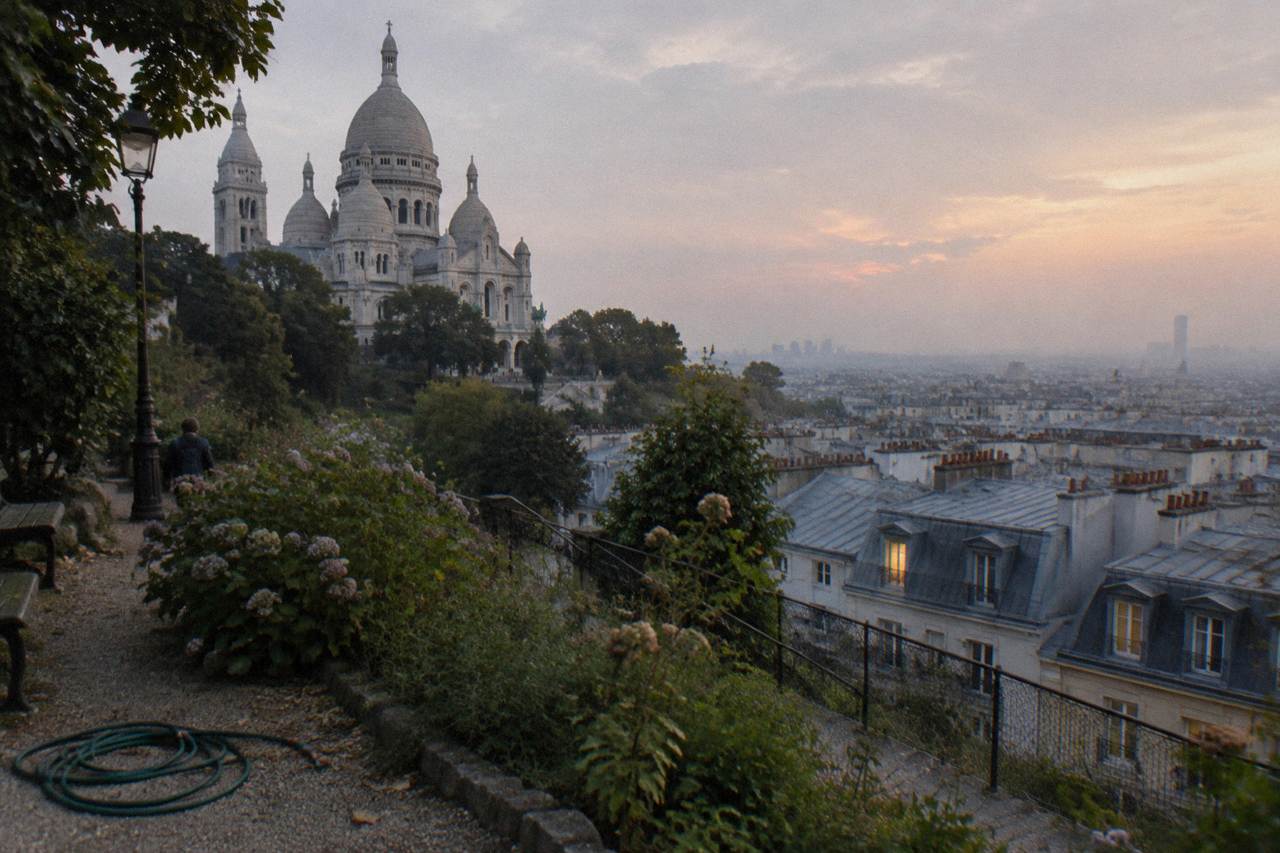
Start with what Montmartre verifiably is. The Butte Montmartre summit sits at 130.53 metres, the highest point in Paris, and the public stairs up to the basilica number 222 steps, a figure the Paris tourism office uses when it describes the funicular that avoids them. The basilica itself is free to enter and open every day from 6:30am to 10:30pm, which means a hotel on the hill puts a world-famous interior and one of the best free views in the city within a short walk of your bed, at any hour you like. The dome costs 8 euros for adults and 5 euros for children up to 15, tickets sold on site only, and the climb is about 280 steps with no elevator.
Le Marais does not get the same numeric treatment here. This site focuses on Montmartre, so the head-to-head between the two neighborhoods stays qualitative rather than statistical. What can be said at a general level is that it is a central, largely flat Right Bank neighbourhood of boutiques, mansion museums and squares, and that travellers choose it for centrality and flatness. Both of those are real advantages. Neither can be honestly ranked against Montmartre's numbers here, so the comparison below sticks to what each area does differently rather than pretending to a scorecard.
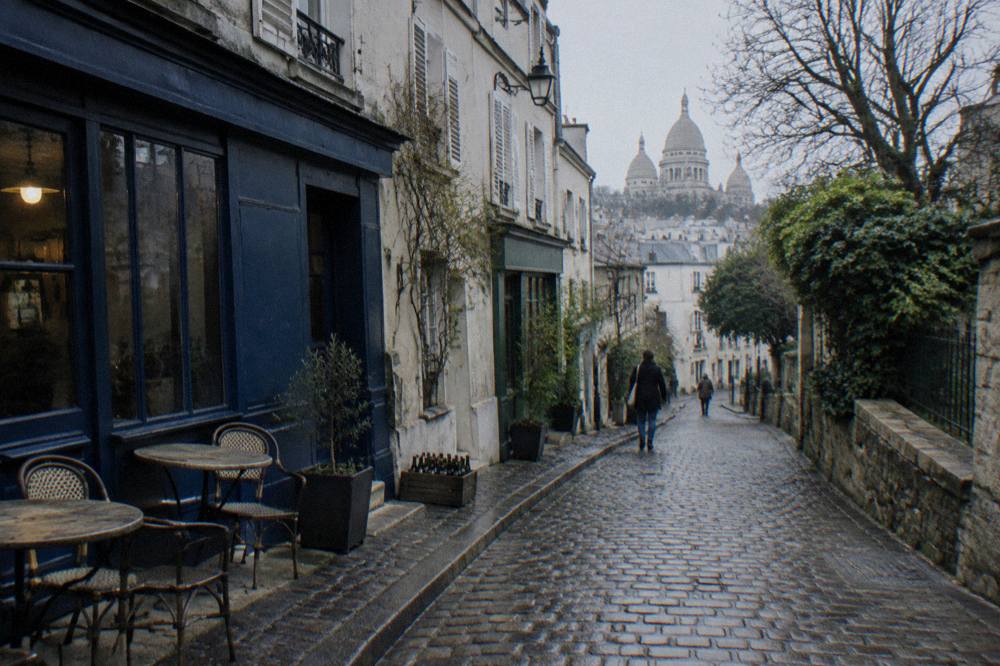
If you stay in Montmartre, the guided walks start on your doorstep. Five classic walking tours, three art tours, four food and wine tours, two Sacre-Coeur focused tours and two private tours all depart from meeting points inside the neighbourhood, most of them clustered around the Blanche and Anvers metro stations and Place Saint-Pierre. That concentration is unusual in Paris, and it is the single strongest practical argument for sleeping on the hill if walking is the point of your trip.
Is Montmartre A Good Area To Stay In Paris?
Yes, for a particular kind of trip: one built around walking, views and village-scale street life, with the caveats that the hill is genuinely steep and the neighbourhood sits at the edge of the centre. The basilica is free and open 6:30am to 10:30pm, the funicular runs 6am to 12:45am, and every tour on this site's roster departs from inside the neighbourhood. If flat, central convenience matters more, it is the weaker choice.
The case for staying here starts with the mornings. The basilica opens at 6:30am and entry is free, so an early riser staying on the hill can have the forecourt and the interior nearly to themselves hours before the crowds arrive, then be back at the hotel for breakfast. The basilica's practical information notes a possible wait of 10 to 15 minutes at the busiest daytime hours, which is exactly the wait the early visitor skips. If you're weighing the rest of the day too, our guide to Montmartre by morning versus evening compares light, crowds and tour times to help you pick your slot.
The second argument is the walkability itself. The hill's street plan predates the grand boulevard rebuilding that reshaped central Paris, so it works as a village: lanes, staircases, small squares, the vineyard on rue des Saules, the painters' pitches on Place du Tertre where the Ville de Paris licenses 124 numbered spots to authorised artists working on site. A stay here is not a commute into an attraction, it is living inside the attraction, and the question of how long you need up here has its own answer, covered in how many hours you need in Montmartre.
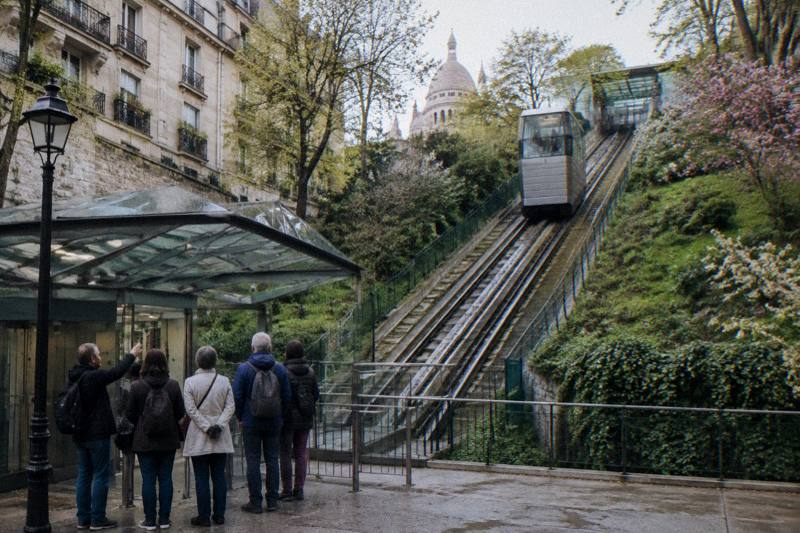
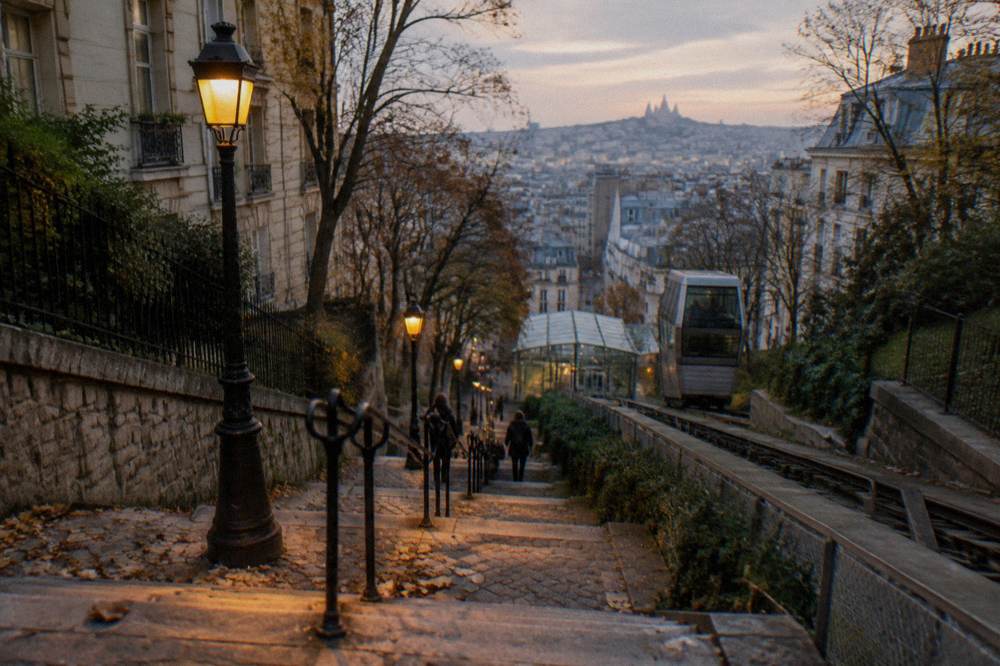
The honest downsides are two. First, the geography: 222 public steps to the basilica, a summit above 130 metres, and a funicular that costs the same as a metro ticket to save your legs, running every day from 6am to 12:45am with a ride time of 1 minute 30 seconds. Anyone with mobility limits should weigh that seriously, and the question is examined in detail in is Montmartre difficult to walk. Second, the location: Montmartre sits in the 18th arrondissement, north of the centre, so trips to the Louvre or the Latin Quarter involve a metro ride rather than a stroll. The Marais is closer to more of the classic sights on foot.
What Does Le Marais Offer That Montmartre Does Not?
Flat ground, a more central position between the Louvre and Bastille, mansion museums and a dense boutique-and-café scene, all reasons the Marais suits visitors who want an easy stroll between sights rather than a hill climb. Montmartre offers the hill, the basilica, the vineyard and the deepest concentration of guided walks. These are different products, not two versions of the same one.
Be explicit about the evidence problem, because most articles on this question do not. A typical "Marais vs Montmartre" piece will quote average hotel rates for both, a safety index, a "walkability score". None of those figures exist in a verified primary source for this comparison, and inventing them would be exactly the kind of fabricated precision this site refuses. So the Marais side of the ledger stays qualitative.
What can be said generally is this. The Marais is a Right Bank neighbourhood that was largely spared the boulevard rebuilding that reshaped central Paris, which is why it is full of historic mansions turned into museums. It is flat, which after a day on Montmartre's stairs is not a small thing. It sits within an easy walk of the Louvre and the Seine, which Montmartre does not. Its squares and rue-lined shopping make it a strong pick for visitors whose ideal day is museum, boutique, café, museum.
Montmartre's counteroffer is a different shape of day. Instead of mansions, the hill gives you the Sacre-Coeur, free and open daily, its dome climbable for 8 euros, and instead of boutiques, the artists of Place du Tertre working under a 7-year municipal authorisation at a 334.28 euro annual fee per pitch. Instead of flat convenience, the vineyard of Clos Montmartre, 1,762 vines on 1,556 square metres, viewable from the street and open to the interior only on guided visits. And instead of museums on foot, the Moulin Rouge at 82 Boulevard de Clichy, created 1889, whose dinner-and-show evenings start at 7pm, and which the neighbourhood's walking tours pass from the outside without entering.
If you do choose the hill, the walking tours are the fastest way to learn the neighbourhood you have just moved into, and the featured option is the Montmartre Highlights Walking Tour: 2 hours 20 minutes with a local guide, a small group capped at 16, a 4.9 rating from 2,825 reviews, and a meeting point near the carousel at Place Saint-Pierre, with free cancellation. It is a genuine orientation tool for a stay, not just a sightseeing tick.
What Is The Difference Between Montmartre And Montparnasse?
**Montmartre is a hilltop village in the 18th arrondissement, built around the Sacre-Coeur, its staircases and its artist history; Montparnasse is a Left Bank quarter around a mainline railway station and a 1970s office tower, with a café-and-artists past of its own. They share a bohemian reputation and almost nothing else, and travellers confuse the names constantly. Everything in this article covers Montmartre only.
The confusion is understandable and worth killing early, because "Montmartre" and "Montparnasse" both start with Mont and both are associated with early 20th-century art. But the two places are on opposite banks of the Seine and are not interchangeable. Montmartre is the hill in the north of Paris: the basilica, the vineyard, the Moulin Rouge at its foot, the studios where Picasso painted Les Demoiselles d'Avignon in 1907 and where Van Gogh lived with his brother Theo at 54 rue Lepic during his Paris years, 1886 to 1888. Montparnasse, by contrast, is the Left Bank quarter around the train station of the same name; its artistic era was the interwar one, and its modern identity is transport and office blocks. Solid, checkable information exists for Montmartre, but not for Montparnasse, so this page makes no price, safety or convenience comparison between the two. Any article that offers one without saying where its numbers come from deserves suspicion.
The practical relevance to a stay is simple: check your hotel's arrondissement before booking. A "Paris Montmartre" hotel that turns out to be near Montparnasse station is a 20-plus minute metro ride from the Butte, and the reverse mistake strands a Marais-minded traveller on a hill.
Which Area Should You Choose For Your Trip?
Choose Montmartre if walking, views, morning access to a free basilica and food-market streets define your ideal Paris day, and if you accept stairs and a metro ride to the centre. Choose the Marais if you want flat ground, museums within a short walk and a central position, and you are willing to travel to reach the hill. Split stays are also legitimate: several nights in each gives you both Parises.
Here is the decision table, built from the tour listings themselves.
| Question | Stay In Montmartre | Stay In Le Marais |
|---|---|---|
| Ground underfoot | Steep hill, 222 public steps to the basilica, funicular available | Flat, level walking throughout |
| Signature free sight | Sacre-Coeur, free entry, open daily 6:30am to 10:30pm | Mansion museums and squares, generally ticketed |
| Guided walks at the door | 16 bookable tours depart inside the neighbourhood | None documented in this site's research |
| Food touring | Cheese, wine and pastry walks plus tasting routes, up to 3.5 hours | No verified roster from this site's file |
| Position | 18th arrondissement, north of the centre, metro to the Louvre | Central Right Bank, walkable to the Louvre and the Seine |
| Evening anchor | Moulin Rouge, dinner and show from 7pm, passed by walks outside | Café and boutique scene, general level only |
Two transport facts belong in the decision. The Navigo monthly all-zones pass costs 90.80 euros, reduced 45.40, from 1 January 2026, which matters to anyone planning a longer stay and daily metro use from either neighbourhood. And the old cardboard t+ tickets are no longer sold since November 2025: remaining paper tickets are accepted on the metro and RER until 14 December 2026, with the digital Navigo Easy replacing them, so a visitor arriving with outdated advice about paper tickets should plan on a phone or a pass. The funicular, for its part, costs the same as a metro ticket and takes 1 minute 30 seconds for the ride, per the Paris tourism office's funicular page.
Accommodation cost is the one thing this table deliberately leaves blank. Hotel rates in both neighbourhoods shift with the season and the booking window, so it makes more sense to check live prices for your dates than to rely on a fixed figure here. What can be stated is the official tax framework every Paris hotel charges: from 1 January 2026 the tourist tax runs at 5.53 euros per adult per night at a 3-star property and 3.25 euros at a 2-star, as published by the French service-public site. That tax applies identically in both neighbourhoods, so it does not break the tie, but it belongs in any honest nightly-budget calculation, and a traveller comparing rates should add it to the quoted room price in either arrondissement.
If the hill wins your decision, one more planning note: the Fete des Vendanges de Montmartre runs 7 to 11 October 2026, the 93rd edition, and the Clos Montmartre harvest brought in 1,329 kg of grapes on 17 September 2026, pressed at the 18th arrondissement town hall. A stay during the festival week puts parades, tastings and the vineyard at the centre of neighbourhood life, though guided vineyard visits require booking and fill early. The basilica's own visitor information, including dome hours and the organ restoration running through the end of May 2027, is on the official Sacre-Coeur site.
How Do You Make The Most Of A Montmartre Stay?
Sleep low or mid-hill near the Blanche or Anvers side to keep the stairs optional, use the funicular for the last climb, book one guided walk early in the stay as an orientation, and give the neighbourhood your evenings, when the day-trippers have gone and the basilica is still open until 10:30pm. The tours below are the ones departing within a few minutes' walk of most hill addresses.
The first-night move that pays off all week is a small-group walk. The Montmartre Small Group Walking Tour runs 2 hours 15 minutes capped at just 10 guests, the smallest cap on this site's roster, meets near the Blanche metro exit by the Moulin Rouge, carries a 4.9 rating from 576 reviews, and offers free cancellation. A group that size lets you ask a local guide the questions a hotel concierge cannot answer from lived experience: which staircase shortcuts the crowd, which bakery earns the queue.
Then let the food tours do the provisioning. The cheese, wine and pastry walk runs 3 hours with a cap of 12 and tastings of pastries, savory specialties, chocolates, cheese and charcuterie, with a 4.9 rating from 2,395 reviews, the deepest food-tour review pool on the roster. The ten-tastings route run by Secret Food Tours runs longer at 3.5 hours and adds a "secret dish" alongside wines, meeting at Anvers metro on weekdays and Abbesses on weekends, with a 4.8 rating from 276 reviews and a "likely to sell out" badge worth taking seriously. Either one converts a first evening into a working map of the neighbourhood's shops, which is exactly what a stay, as opposed to a visit, needs.
Where you start your first walk matters too, and the question has its own treatment in where to start your walk in Montmartre, while the broader choice between going alone and going guided is weighed in guided versus self-guided Montmartre tours.
Common Questions About Staying In Le Marais Or Montmartre
Is It Better To Stay In Le Marais Or Montmartre?
It depends on the trip. Montmartre suits visitors who want a hilltop village, free basilica access from 6:30am to 10:30pm, and guided walks departing on the doorstep, accepting stairs and a metro ride to the centre. Le Marais suits visitors who want flat ground and a central position. No reliable numbers exist for hotel prices or safety here, so treat any verdict as a starting point rather than a final word.
Is Montmartre A Good Area To Stay In Paris?
Yes for a walking-and-views trip. The neighbourhood holds 16 bookable guided tours departing inside its streets, a free basilica open daily 6:30am to 10:30pm, a funicular running 6am to 12:45am, and a village street plan. The trade-offs are the steep hill and a location at the northern edge of the centre.
What Is The Difference Between Montmartre And Montparnasse?
Montmartre is a hilltop village in the 18th arrondissement around the Sacre-Coeur; Montparnasse is a Left Bank quarter around a mainline station and office tower. They share a bohemian reputation and little else. Check your hotel's arrondissement before booking, because the two are a 20-plus minute metro ride apart.
Is Montmartre Too Hilly For Older Visitors?
The hill is real: 222 public steps lead to the basilica, and the dome adds about 280 more. The funicular costs the same as a metro ticket and covers the main climb in 1 minute 30 seconds, and the metro stations serving the hill are Blanche and Anvers on line 2 and Abbesses on line 12. Anyone with mobility limits should weigh the stairs seriously and lean on the funicular.
Can You Visit The Sacre-Coeur Dome On A Montmartre Stay?
Yes. The dome is open daily from 10:30am with last admission about 7pm, costs 8 euros for adults and 5 euros for children up to 15, and tickets are sold on site only. The climb is about 280 steps with no elevator, and the basilica itself remains free to enter every day from 6:30am to 10:30pm.