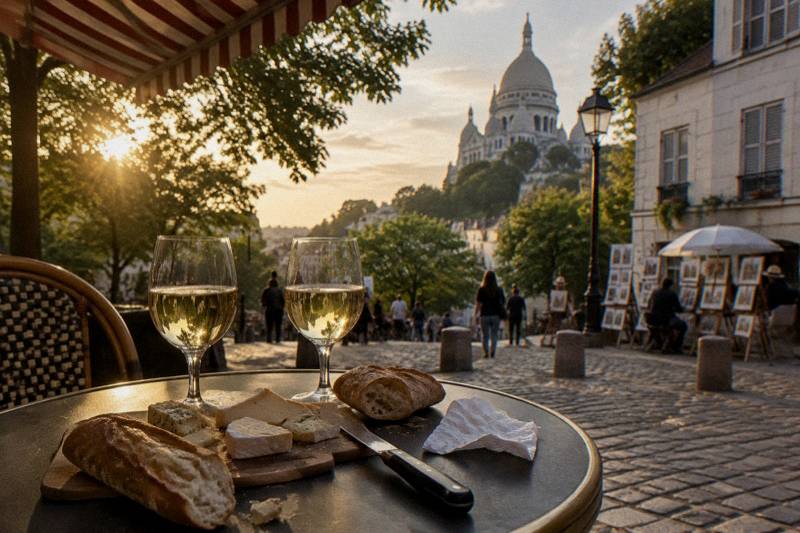
How Much Should A Food Tour Cost?
A plain-language benchmark for food tour pricing in Montmartre: what the standard walks cost by tier, what pushes a listing into the private tier, and how to judge whether a price is fair.
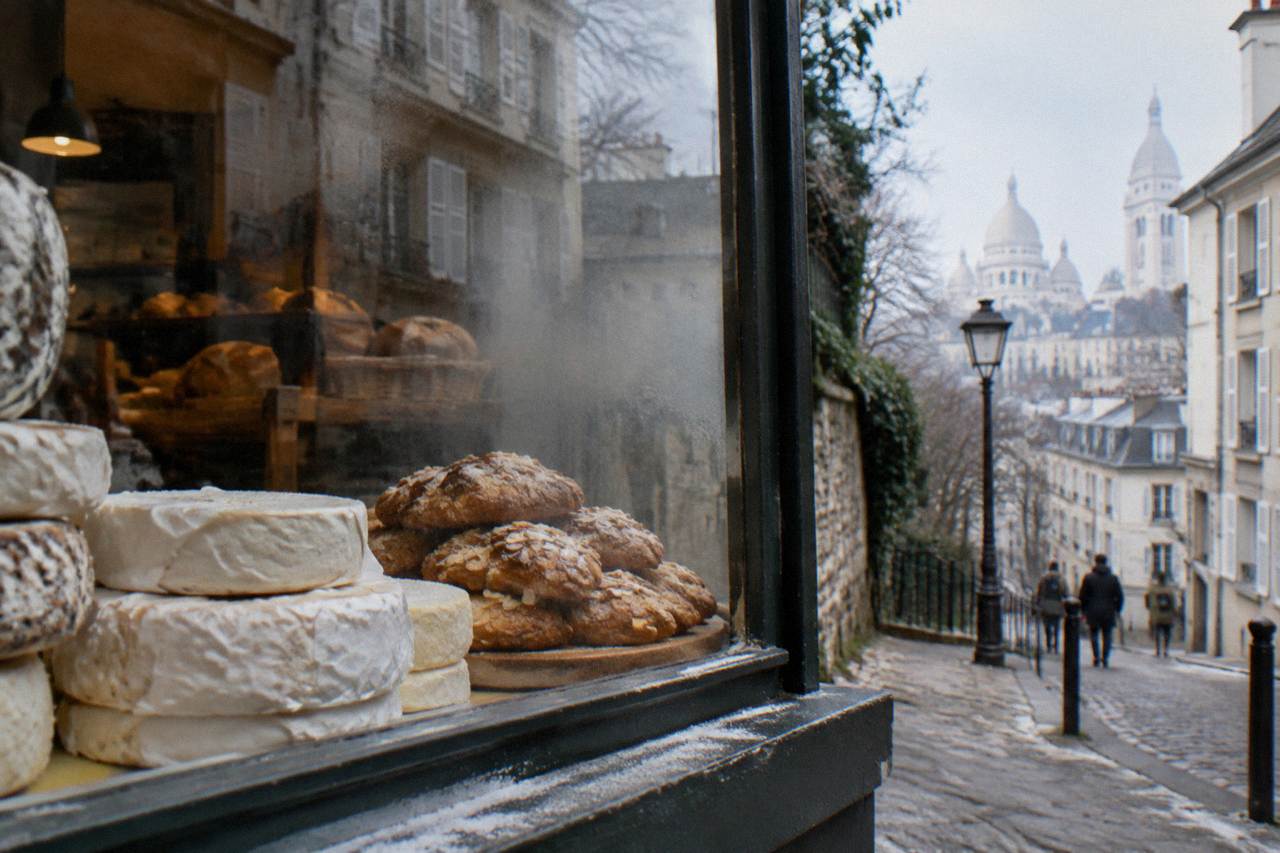
Food tour pricing confuses people because the listings rarely explain themselves. Two walks of similar length can sit in different price tiers for reasons that only become clear when you read the fine print: the group cap, the number of tastings, whether wine is poured, and whether the whole thing is private. Montmartre, with its cheese shops, pastry counters and vineyard history, is a good place to work through the question, because the hill carries a full spread of options, from a short classic walk to a private food route. If you'd rather see the hill after dark, the Montmartre evening and sunset walking guide explains what changes once the daytime crowds thin out.
The honest answer is that there is no single fair price. There are tiers, and a listing belongs to a tier for reasons you can check before you pay. This article benchmarks the four food and wine listings on the Montmartre roster against each other, explains what pushes a tour up or down the scale, and gives you a way to judge any food tour price you meet, in Paris or anywhere else.
How Much Should A Food Tour Cost?
A standard small-group food walk in Montmartre sits in the food-tour price tier, well above the classic sightseeing walks but far below a private guide, and the from-price on each listing reflects the format rather than the quality. Three shared tours cluster in that food-tour tier, while the private food tour occupies a premium tier on its own. Within the standard tier, price moves with tasting count, group cap and wine.
That is the benchmark in one paragraph. The three shared listings, the ten-tastings route run by Secret Food Tours, the Eating Paris walk with 8 food stops and the cheese, wine and pastry tour, all sit in the same food-tour tier. The private food tour with wine, cheese and pastries sits in the private tier, priced per person rather than per booking. None of the classic walking tours, the 90-minute art, culture and food walk included, costs as much as a full food tour, because a food tour buys actual food, not just commentary.
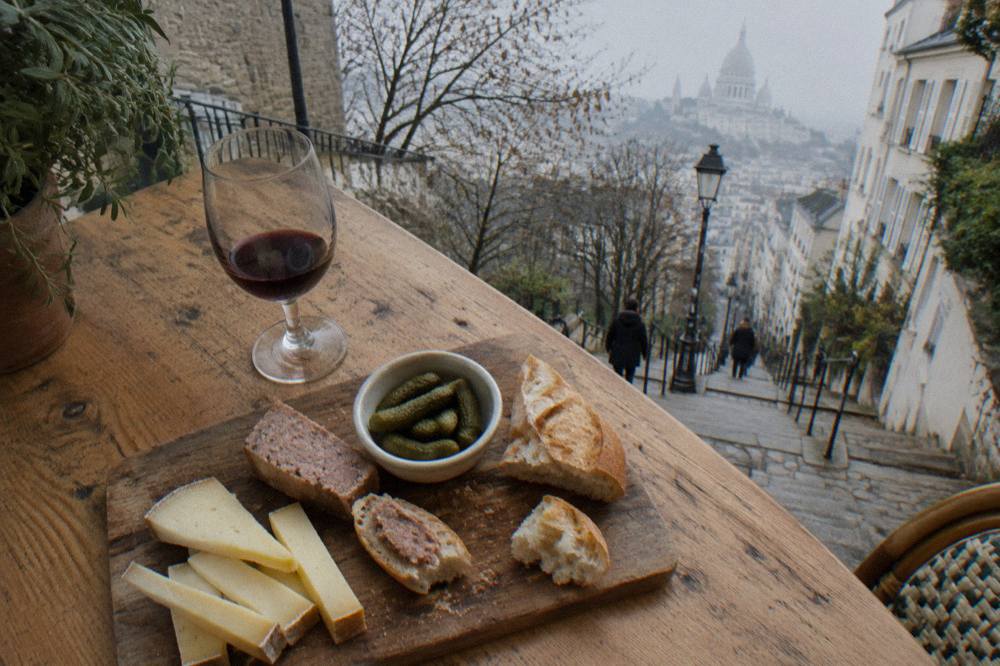
The comparison that matters is not food tour against food tour, but food tour against the alternative of eating your way up the hill on your own. A food tour bundles a route, a guide who knows the shops, and roughly ten tastings with drinks into one ticket. Done independently, the same cheese, pastry, chocolate and charcuterie stops would cost money anyway, and you would miss the context. Whether the bundle is worth it is a separate question, covered in our piece on whether a Paris food tour is worth the money.
Start with the three standard listings side by side, then look at what separates them.
The ten-tastings tour run by Secret Food Tours is the longest of the standard walks at 3.5 hours, and its listing states pastries, macarons, a crepe, chocolates, cheeses, cured meats, bread, a "secret dish", red and white wine, water and soft drinks. It rates 4.8 from 276 reviews and carries a likely-to-sell-out badge. One planning note: the meeting point shifts between Anvers metro on weekdays and Abbesses metro at weekends and for 6pm starts, so check departure times on the listing for your date rather than assuming a fixed spot.
What Drives The Price Of A Montmartre Food Tour?
Four things move a food tour between tiers: the group cap, the number of stated tastings, whether wine is included, and whether the format is private. Group size is the biggest single lever, because a cap of 10 or 12 means the operator buys more food per guest and pays a guide for a smaller group. Private format multiplies the price again, since one booking covers the whole outing.
Group cap first. The Eating Paris walk caps at 10 guests, the cheese, wine and pastry tour caps at 12. Both are genuinely small groups, and the per-person food budget reflects that. A listing that caps at 25, like the 90-minute art, culture and food walk, can charge less per head because the operator's costs divide further, but the experience is a different shape: less conversation, less plate space, a faster pace.
Tasting count is the second lever, and the listings state it differently. The Eating Paris tour names 8 food stops featuring 10 food and 2 drink tastings, including oysters, sausage and aligot, with artisan shops along the way. The Secret Food Tours listing names its ten tastings plus wine and soft drinks. When a listing is vague about what is served, treat that vagueness as information: a price without a stated tasting list is harder to judge, and the honest operators tend to itemize.
Wine is the third. Both standard tours pour wine as part of the ticket, which in Paris is not a trivial add-on. A walk that includes two glasses per person is buying cellar stock at retail-plus, and the listing passes that through.
Private format is the fourth, and it changes the arithmetic completely. The private Montmartre food tour with wine, cheese and pastries runs 3 to 4 hours and prices per person, not per booking. One plain warning that belongs in any honest discussion of that listing: it is non-refundable, with no free cancellation, unlike every other listing discussed here. If your travel dates might shift, that policy is part of the real cost.
| Price driver | What it does to cost | What to check on the listing |
|---|---|---|
| Group cap | A cap of 10 to 12 raises the per-person food budget; a cap of 25 lowers the ticket | The "small group" line and the stated number |
| Tasting count | More stated tastings mean more bought food; vague lists hide the value | Whether the listing itemizes stops and servings |
| Wine included | Adds a real per-person cost the operator passes through | Whether drinks are listed as included or excluded |
| Private format | One booking covers the whole group, multiplying the price | Whether the price is per person or per group |
| Cancellation policy | A non-refundable ticket carries risk cost if plans change | The refund terms before you book |
If you already know you want a guided route up the hill but food is secondary, the Montmartre food tour guide walks through all four listings in detail, and the tours hub covers the non-food options.
How Do The Standard Food Walks Compare?
The three shared food tours cost the same order of magnitude and differ mainly in shape: the cheese, wine and pastry tour runs 3 hours with a cap of 12 and rates 4.9 from 2,395 reviews, the deepest food-tour review pool on this roster; the Eating Paris walk runs 3 hours with a cap of 10 and rates 4.9 from 868; the ten-tastings route runs 3.5 hours and rates 4.8 from 276.
Ratings that close tell you almost nothing about relative quality. A 4.9 from 2,395 reviews and a 4.9 from 868 both describe walks that guests consistently enjoy. What should actually drive your choice is format: duration, cap, meeting point and what is on the table. The cheese, wine and pastry tour lists tastings of pastries, local savory specialties, homemade chocolates, cheese and charcuterie, and meets outside the Starbucks and pharmacy near Blanche metro. The Eating Paris walk meets outside Le Pain Quotidien on Rue Lepic and names its 8 food stops and 10 food plus 2 drink tastings explicitly, including oysters.
| Listing | Duration | Group cap | Stated tastings | Rating and reviews |
|---|---|---|---|---|
| Cheese, wine and pastry tour | 3 hours | 12 | Pastries, savory specialties, chocolates, cheese, charcuterie | 4.9 from 2,395 reviews |
| Eating Paris Montmartre food tour | 3 hours | 10 | 8 stops, 10 food and 2 drink tastings, oysters, sausage and aligot | 4.9 from 868 reviews |
| Ten local tastings with wines | 3.5 hours | Small group | Pastries, macarons, crepe, chocolates, cheeses, cured meats, bread, a secret dish, wine | 4.8 from 276 reviews |
| Private food tour with wine, cheese and pastries | 3 to 4 hours | Private | Wine, cheese and pastries, per the listing | 4.9 from 1,141 reviews |
The cheese, wine and pastry tour deserves its own look if tastings-per-euro is your metric. It holds the deepest review pool of any food tour on the roster, and its stated inclusion list is the most itemized of the three shared walks.
One contrast worth making: if food is a nice-to-have rather than the point, the hidden-gems walk run by Intrepid Urban Adventures includes a freshly baked croissant from an award-winning bakery alongside hidden streets, stairways and panoramic views, and sits in the mid tier, below the food-tour tier. Two hours, a cap of 14, a rating of 4.9 from 1,031 reviews. It is a walking tour with a pastry, not a food tour, and the price difference reflects exactly that.
Is The Private Food Tour Worth The Premium Tier?
The private food tour prices per person rather than per booking, which puts it in the private tier above all the shared walks, and it is the only listing on the entire Montmartre roster with no free cancellation. Whether it is worth the premium depends on group size: for a couple it competes with two shared-walk tickets, for a family of five it can undercut five separate seats. To see exactly where the break-even point falls for your group, our guide to when a private Montmartre tour is worth it runs through the math.
The arithmetic is the whole argument. A private tour's cost divides across your party. Two people comparing the private tier against two seats on a shared walk will find a real gap; six people will find the gap shrinking fast, and they get the route to themselves, a 3 to 4 hour window, and a guide whose attention is not split across strangers. The listing rates 4.9 from 1,141 reviews, a substantial pool for a private format, and meets at Anvers metro on weekdays and Abbesses on other schedules. The wider set of guides lives on Montmartre Paris Tours.
The cancellation policy is the part to read twice. Every other listing discussed in this article offers free cancellation. The private food tour does not: it is non-refundable. If your Paris dates are fixed, that may not matter. If they are not, the risk is real and belongs in your cost calculation, and a shared walk with free cancellation may be the more sensible buy even at a similar total.
There is also a middle path that people forget. The semi-private and private walking tours that focus on Sacre-Coeur and the district, like the Babylon Tours exclusive walk with its cheaper semi-private option, show how operators price format alone, without food. Comparing a private walk against a private food tour isolates what the food itself costs you.
What About Wine And The Vineyard Angle?
Montmartre is the only Paris hill with a working vineyard, the Clos Montmartre at 14 rue des Saules, and that history is why wine features so heavily in the local food tours, but no tour on this roster enters the vineyard: public access there is by guided visits only, booked separately. The wine you taste on a food tour is not the vineyard's cuvee.
The vineyard holds 1,762 vines on 1,556 square metres, mostly gamay with some pinot, and produces about one tonne of grapes a year, vinified in the 18th arrondissement town hall cellars into close to 2,000 half-litre bottles, according to the Ville de Paris vineyard page. The city planted 2,000 vines there in 1932. It is a working clos, not a visitor attraction you can wander, and the official access page states entry is by guided visit only.
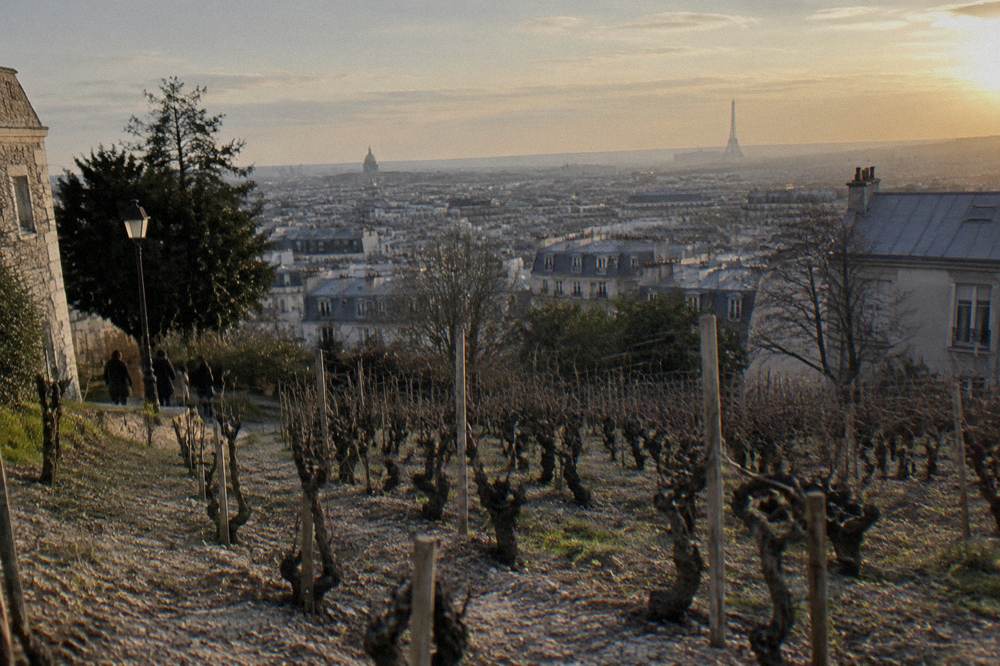
So when a food tour lists wine, read it as French wine, not Montmartre wine. The vineyard's own bottles are rare, auctioned and festival-linked, and the tours that pass the clos on rue des Saules, as the hidden-gems walk does, view it from the street. If the vineyard itself is your interest, the Montmartre vineyard and wine guide covers the festival and the guided-visit route. If you are timing a visit, the harvest festival in early October is the one week when the hill's food culture is at its loudest, and the official festival program lists what needs booking.
How Do You Judge Whether Any Food Tour Price Is Fair?
Judge a food tour price against four checks: the stated tasting count, the group cap, the duration, and the cancellation terms. A fair price itemizes what you will eat, caps the group small enough that everyone gets served, and gives you a refund window. If a listing fails two of those four checks, the price is not the problem, the listing is.
The tasting count is the first check because it is the product. A listing that names ten tastings is selling ten tastings; a listing that says "local specialties" is selling a promise. The group cap is the second, because food divided twelve ways is a different meal from food divided twenty-five ways. Duration is the third, and it is where the Montmartre roster is unusually transparent: 3 hours for two of the shared walks, 3.5 for the third, 3 to 4 for the private tour.
The fourth check is the refund policy, and it is the one people skip. Fifteen of the sixteen listings on this site's roster offer free cancellation, which makes the one non-refundable listing, the private food tour, stand out clearly. A non-refundable ticket is not a bad product, but it is a riskier one, and the price should be judged with that risk attached.
A final sanity check: compare the ticket against the food you would buy anyway. If a walk includes a pastry, cheese, charcuterie, chocolate and two glasses of wine, you can estimate what that costs at Montmartre prices, and the guide, the route and the small-group format are what you are paying on top. That mental sum, not a platform's badge or a review average, is what tells you whether a price is fair. For the wider framing, our guide to the Montmartre food tour scene and the piece on how many hours you need in Montmartre help you fit the ticket into a day. If that mental sum still leaves you unsure, our piece on whether a Paris food tour justifies its price walks through what the tastings actually cover and who should skip the format altogether.
Three listings cover the standard tier, and the private tour covers the premium tier, which is the full spread on this hill. If you are ready to compare live prices, the listings below show current availability.
Common Questions About Food Tour Pricing
How Much Should A Food Tour Cost?
A standard small-group food tour in Montmartre sits in the food-tour tier, above the classic walking tours and below a private guide. The from-price on each listing shows the tier; three shared tours cluster together, and the private food tour occupies the premium tier alone, priced per person rather than per booking.
Why do food tours cost more than walking tours?
Because the ticket buys food, not just commentary. A food tour operator pays for every tasting served, plus wine where it is included, on top of the guide. A classic walking tour has no per-head food budget, which is why the lowest-priced walks and the food-tour tier never overlap.
Is a private food tour worth the extra cost?
It depends on your group size. The private Montmartre food tour prices per person, so a family can find it competitive against several shared-walk seats, while a couple pays a clear premium for exclusivity. Note that this listing is non-refundable, with no free cancellation, unlike the shared tours.
Do the wine tastings on these tours use Montmartre wine?
No. The Clos Montmartre vineyard's bottles are produced in tiny quantities and its public access is by guided visit only. The wine poured on the food tours is French wine from elsewhere, and no tour on this roster enters the vineyard.
Does a higher price mean a better food tour?
Not reliably. The ratings across the Montmartre food listings run from 4.8 to 4.9, essentially indistinguishable, while the prices differ by tier for structural reasons: group cap, tasting count, wine and private format. Judge the structure, not the price tag.
What should I check before booking any food tour?
Four things: the stated tasting count, the group cap, the duration, and the cancellation terms. A listing that itemizes its tastings, caps the group at 10 to 12 and offers free cancellation is priced honestly whatever tier it sits in. A vague listing at any price deserves skepticism.